From Wikipedia
Open on Wikipedia
| Cecropia moth | |
|---|---|

| |
| Mounted adult female | |
Scientific classification 
| |
| Kingdom: | Animalia |
| Phylum: | Arthropoda |
| Clade: | Pancrustacea |
| Class: | Insecta |
| Order: | Lepidoptera |
| Family: | Saturniidae |
| Genus: | Hyalophora |
| Species: | H. cecropia
|
| Binomial name | |
| Hyalophora cecropia | |
| Synonyms | |
| |
Hyalophora cecropia, the cecropia moth, is North America's largest native moth.[1] It is a member of the family Saturniidae, or giant silk moths. Females have been documented with a wingspan of five to seven inches (13 to 18 cm) or more. These moths can be found predominantly across eastern North America, with occurrences as far west as Washington and north into the majority of Canadian provinces.[2] Cecropia moth larvae are most commonly found on maple trees, but they have also been found on cherry and birch trees, among many others. The species was first described by Carl Linnaeus in his 1758 10th edition of Systema Naturae.
Life cycle
[edit]
Like other members of the giant silk moth family, the adult cecropia moth lacks functional mouth parts and a digestive system. Due to this, they survive for approximately two weeks.[3]
To find a mate, the female cecropia moth emits pheromones which the male detects with its sensitive antennae. Male cecropia moths can detect these pheromones from up to a mile away, although a male may fly up to 7 miles while searching for a female. Mating typically begins early in the morning hours and lasts until the evening.
After mating, the female will lay up to one hundred eggs. These eggs are mottled reddish brown and usually found on either side of a host leaf. These eggs will eventually hatch into tiny black caterpillars.
There are typically five larval instars (developmental stages), each lasting approximately one week. The first instar larvae are black. Their coloration is due to small black hairs growing from tubercles (small projections) all over their body. These larvae feed upon many common trees and shrubs, including maple, birch, and apple.[4] As the caterpillars grow larger into the second larval instar, they become yellow green. During the third, fourth, and fifth instars, the cecropia moth becomes rather large and bluish green. At these final stages, the tubercles become blue, yellow, or orange, depending on the location on the body, while the black hairs are eventually lost. The caterpillars reach maturity in autumn and are about 4 to 4.5 inches (100 to 110 mm) long.[5]
Once the caterpillars reach maturity, they spin large brown cocoons longways on trees or wooden structures. They will then emerge as adults in the first two weeks of seasonally warm weather in early summer. Hyalophora cecropia moths are univoltine, with only one generation per year.
Upon reaching adulthood, their size is variable. They are usually quite large, with a wingspan of about 5 to 7 inches (130 to 180 mm). The cecropia moth's wings are brownish with red near the base of the forewing. There are crescent-shaped spots of red with whitish centers on all wings, but they are larger on the hindwings. All wings have whitish coloration followed by reddish bands of shading beyond the postmedial line that runs longitudinally down the center of all four wings. The body is hairy, with reddish coloring on the anterior, and fading to reddish/whitish. The abdomen has alternating red and white bands.[6]
Threats
[edit]Moth pests have become a significant problem.
Parasitoids, such as some species of wasps and flies, lay their eggs in or on the young caterpillars. The eggs then hatch into larvae, which consume the caterpillar's internal organs and muscles. The parasitoid releases chemicals that override the regulatory mechanisms of the caterpillar. Once the parasitoid has grown enough, it induces the caterpillar to pupate. Once the caterpillars pupate, the parasitoid larvae themselves pupate, killing the cecropia pupa.[7]
Squirrels also consume the pupae of cecropia moths, which can significantly decrease their populations.
Pruning of trees and leaving outdoor lights on at night can also be detrimental to cecropia moths.
Compsilura concinnata, introduced to North America to control the invasive gypsy moth (Lymantria dispar), is a particular threat to the native North American cecropia moth.[8]
In science
[edit]The original description of the insect juvenile hormone by Carroll Williams in Nature in 1956 is from the cecropia silkworm.[9] This large insect had enough juvenile hormone in its abdomen to permit the extraction of detectable amounts from a single specimen.
Cecropin, a major protein involved in the humoral immunity of most insects, was first isolated from and named after Hyalophota cecropia.[10]
Accidental Transport
[edit]In August 2012, a cecropia moth caterpillar was accidentally imported from Ontario to St. John's, Newfoundland, via a shipment of dogwood shrubs.[11] Cecropia is not native to the latter province.[12] Within 48 hours of its arrival, the caterpillar began spinning a cocoon; it wintered at the federal Agriculture and Agri-Food research facility in St. John's, which the owner of the importing company had transferred it to. On May 29, 2013, the predominantly black and red female moth — named Georgina by the facility's staff — emerged from her cocoon with a roughly 20 cm (7.9 in) wingspan. After allowing Georgina to complete her natural lifespan, researchers planned to pin and preserve her for future study.[13]
Life cycle gallery
[edit]-
 Cecropia eggs
 -

-
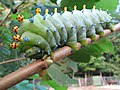 Caterpillar close up
 -
 Female pupa
 -
 Male adult
 -
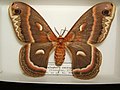 Female adult
 -
 Adult male cecropia shortly after eclosion


References
[edit]- ^ "Cecropia Moth". National Wildlife Federation. Retrieved September 20, 2018.
- ^ Registry-Migration.Gbif.Org (October 15, 2024). "Hyalophora cecropia Linnaeus, 1758". Global Biodiversity Information Facility. doi:10.15468/39omei. Retrieved October 15, 2024.
- ^ "Cecropia Moth — Life Cycle". Archived from the original on 2017-02-02. Retrieved 2013-03-01.
- ^ "Cecropia Moth - Hyalophora cecropia". nhptv.org.
- ^ Gallice, Geoffrey. "Cecropia Moth". University of Florida. Retrieved September 20, 2018.
- ^ Gallice, Geoffrey. "Cecropia moth". Featured Creatures. University of Florida.
- ^ "Parasites, Predators and Parasitoids". Moth Photographers Group. Retrieved September 20, 2018.
- ^ Elkinton, J. S.; Boettner, G. H. The Effects of Compsilura concinnata, an Introduced Generalist Tachinid, on Non-Target Species in North America: A Cautionary Tale (PDF). Archived (PDF) from the original on October 10, 2021. Retrieved January 7, 2025.
- ^ Williams, Carroll M. (1956). "The Juvenile Hormone of Insects". Nature. 178 (4526): 212–213.
- ^ Hultmark D (1982). Insect Immunity: Inducible Antibacterial Proteins from Hyalophota cecropia (PDF) (Ph.D. thesis). University of Stockholm.
- ^ "An uncommon visitor with many little legs". CBC News. August 8, 2012. Retrieved May 31, 2013.
- ^ "Index to the Bombycoidea, Drepanoidea, Lasiocampoidea, and Mimallonoidea of Canada, with regional distributions", Canadian Biodiversity Information Facility, Government of Canada, February 18, 2004, retrieved June 12, 2013
- ^ "Rare stowaway turns into spectacular moth". CBC News. May 31, 2013. Retrieved May 31, 2013.
External links
[edit]

- Picture journal of cecropia development (warning, it may take a while to load)
- The cecropia moth
- Video presentation of mating cecropia moths. One had just emerged from and was still on its cocoon: [1], [2]
- Cecropia moth on the UF / IFAS Featured Creatures Web site
| National | |
|---|---|
| Other | |
