From Wikipedia
Open on Wikipedia
| Swamp dewberry | |
|---|---|

| |
Scientific classification 
| |
| Kingdom: | Plantae |
| Clade: | Embryophytes |
| Clade: | Tracheophytes |
| Clade: | Spermatophytes |
| Clade: | Angiosperms |
| Clade: | Eudicots |
| Clade: | Rosids |
| Order: | Rosales |
| Family: | Rosaceae |
| Genus: | Rubus |
| Species: | R. hispidus
|
| Binomial name | |
| Rubus hispidus L. 1753 not Marshall 1785 nor Mercier 1861 nor Hablitz ex Ledeb. 1844
| |
| Synonyms[1] | |
| |
Rubus hispidus, with the common names swamp dewberry, bristly dewberry, bristly groundberry, groundberry, hispid swamp blackberry or running swamp blackberry, is North American species of dewberry in the rose family.
Description
[edit]Rubus hispidus is a small, herb-like shrub up to 20 centimetres (8 inches) tall. The twigs are red and have bristles.
The flowers are generally in small clumps, each with five white rounded petals. The fruit are dark purple, almost black.[2]
-
 Unripe berries

Distribution and habitat
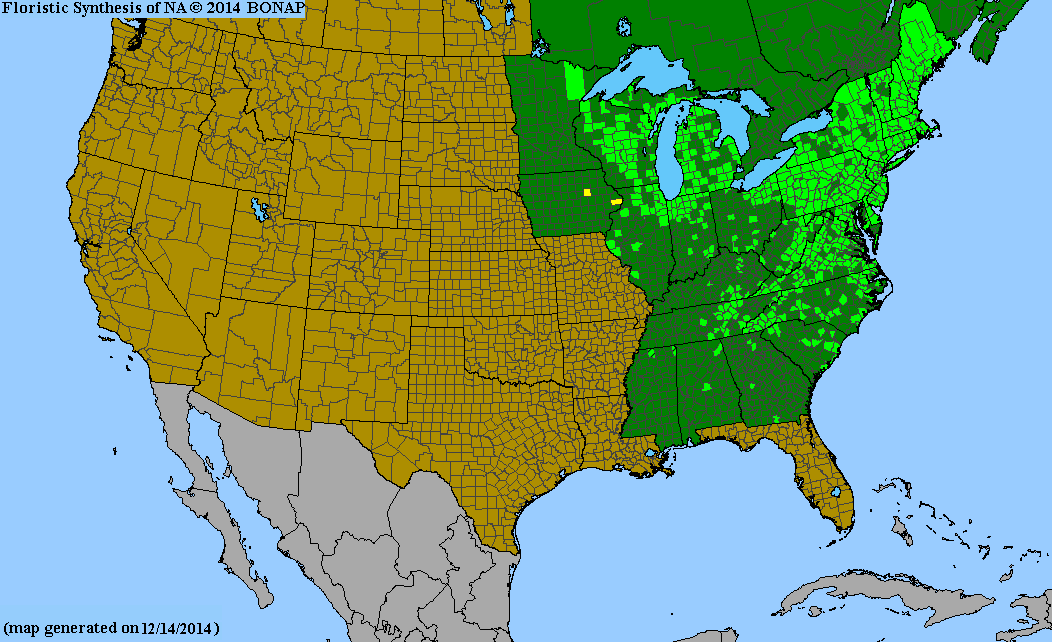
[edit]The plant grows in moist or sometimes dry soils, ditches, swales or open woods in central and eastern North America, from Ontario and Minnesota east to Newfoundland, and south to South Carolina and Mississippi.[3]
Ecology
[edit]The plant is eaten by birds and many mammals.[4]
Uses
[edit]A dull blue dye can be created from its berries. The fruit also can be used as an astringent.[citation needed]
The berries are rather bitter for culinary use, so this plant is not generally cultivated.
References
[edit]- ^ The Plant List, Rubus hispidus L.
- ^ Flora of North America, Rubus hispidus Linnaeus, 1753. Bristly or swamp dewberry, ronce hispide
- ^ Biota of North America Program 2014 county distribution map
- ^ Niering, William A.; Olmstead, Nancy C. (1985) [1979]. The Audubon Society Field Guide to North American Wildflowers, Eastern Region. Knopf. p. 759. ISBN 0-394-50432-1.
External links
[edit] | This fruit-related article is a stub. You can help Wikipedia by adding missing information. |