From Wikipedia
Open on Wikipedia | This article includes a list of general references, but it lacks sufficient corresponding inline citations. (June 2020) |
| Lupinus perennis | |
|---|---|

| |
| At Illinois Beach State Park in Lake County, Illinois | |
Scientific classification 
| |
| Kingdom: | Plantae |
| Clade: | Tracheophytes |
| Clade: | Angiosperms |
| Clade: | Eudicots |
| Clade: | Rosids |
| Order: | Fabales |
| Family: | Fabaceae |
| Subfamily: | Faboideae |
| Genus: | Lupinus |
| Subgenus: | Lupinus subg. Platycarpos |
| Species: | L. perennis
|
| Binomial name | |
| Lupinus perennis | |
Lupinus perennis (also wild perennial lupine, wild lupine, sundial lupine, blue lupine, Indian beet, or old maid's bonnets) is a flowering plant in the family Fabaceae.[2][3]
Description
[edit]The leaves are palmately compound with 7–11 leaflets arranged radially. Their stalks are numerous, erect, striated, and slightly pubescent. The leaflets are obovate, with a blunted apex or pointed spear, and sparsely pubescent.[3] Petioles are longer than leaflets; stipules are very small. The inflorescence is a terminal raceme that may be loosely spaced or weakly whorled. Flower color ranges from white and pink to blue and violet, with blue shades most commonly observed. The calyx is silky and lacks bractlets; its upper lip may be slightly notched while the lower lip is entire and nearly twice as long. The corolla is approximately three times longer than the calyx, and floral bracts are present early but fall off as the flowers mature (Flora of North America, 2023; Rydberg, 1908. Following pollination, the plant produces a legume pod that is yellow-gray to brown, lightly hairy, and constricted between seeds, giving it a bead-like appearance. Pods typically contain five to six seeds, each oval in shape with a pale hilum (Flora of North America, 2023).

The inflorescence is long, sparsely flowered, sometimes almost verticillate. Flowers color can be white, blue, purple, or pink, but are most often blue or bluish purple. The calyx is silky, without bractlets; its upper labium with a protuberant basis, is integral or weakly emarginate, the lower one is integral, almost twice longer than upper. Floral bracts are styliform, shorter than the calyx, early falling. The corolla is three times longer than the calyx. The vexillum is shorter than the wings. The carina is weakly ciliate. Pods are yellow-grayish-brown, with straight lines, necklace-shaped, short and closely hirsute, easy shattered, with 5–6 seeds. Seed is oval with a light hilum.[citation needed]
The germination of this plant isn't too selective over day and night as both still occur equivalently. Researchers found that the seeds of L. perennis require scarification to germinate and ideal temperatures range from 24–29 °C (75–84 °F).[4]
Lupinus perennis is commonly mistaken for the Western species Lupinus polyphyllus (large-leaved lupine), which is commonly planted along roadsides.[5][6] L. polyphyllus is not native to eastern North America, but has naturalized in areas in the upper Midwest and New England.[5][7] L. polyphyllus has 11–17 leaflets that can reach 13 cm (5 in) in length, while L. perennis has 7–11 leaflets which only reach around 5 cm (2 in) in length.[5]
Reproduction and Seed Biology
[edit]Wild lupine reproduces exclusively by seed. Pods mature in mid-summer and dehisce explosively when dry, dispersing seeds short distances from the parent plant (Flora of North America, 2023). Seeds possess a thick, impermeable seed coat that enforces physical dormancy and allows long-term persistence in the soil seed bank. Germination studies show that dormancy is primarily broken through scarification rather than light exposure, with optimal germination occurring at temperatures between approximately 24 and 29 °C (Dakora and Phillips, 2002; Baskin and Baskin, 2014). Biochemical studies indicate that enzymatic activity and stress-related plant hormones contribute to weakening the seed coat and initiating germination. Long-term storage experiments have demonstrated seed viability after more than seventeen years, highlighting the species’ capacity for persistence under unfavorable conditions (Baskin and Baskin, 2014).
Distribution and habitat
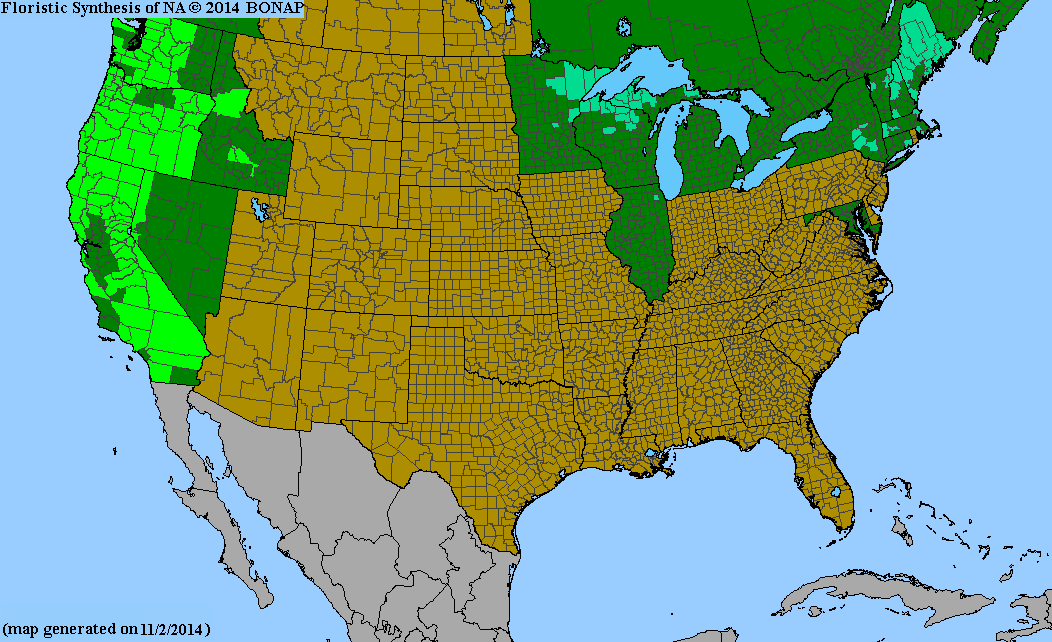
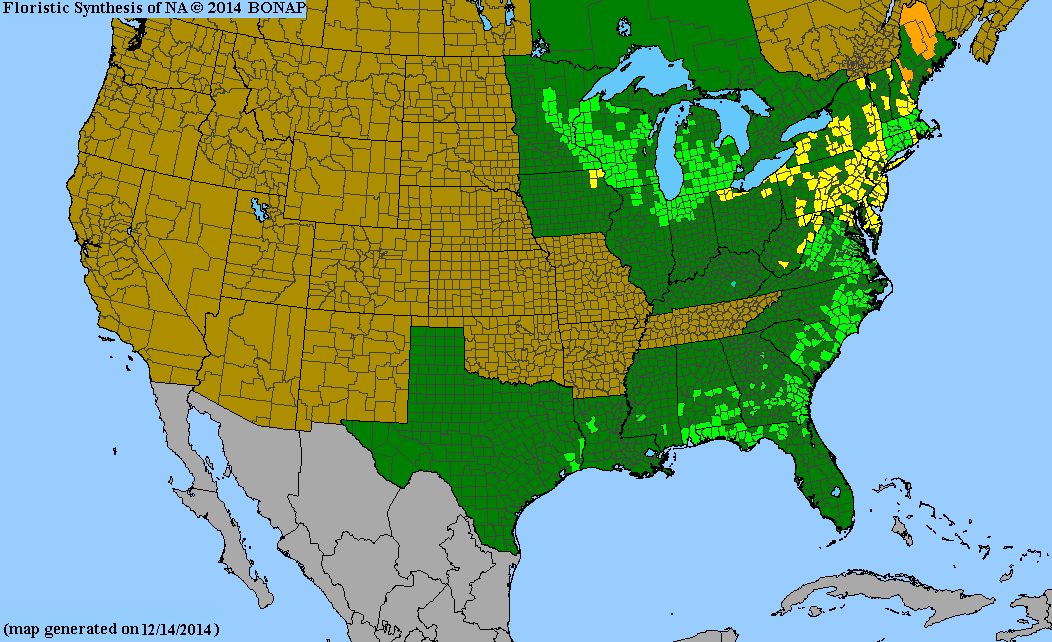
[edit]It is widespread in the eastern part of the USA (from Texas and Florida to Maine) and Minnesota, Canada (southern Ontario, Newfoundland and Labrador), and on the coasts of the Atlantic Ocean, where it grows in sandy areas such as dunes and savannas.[8][9] The species is most commonly associated with well-drained, sandy soils and open, high-light habitats such as oak savannas, pine barrens, dunes, and sand plains. Many of these habitats are disturbance-dependent, and suppression of natural fire regimes has contributed to widespread population declines throughout the species’ range (Rydberg, 1908; GBIF, 2024).
Ecology
[edit]
Lupinus perennis is used as foodplants by the caterpillars of several Lepidoptera. Among these are the clouded sulphur, eastern tailed blue, gray hairstreak, silvery blue, wild indigo duskywing, frosted elfin (Callophrys irus), the eastern Persius duskywing (Erynnis persius persius),[10] and the rare and endangered Karner blue (Plebejus samuelis), whose caterpillars feed only on the lupine leaves.[11] Leaves that have been fed on by Karner blues have distinctive transparent areas where the larvae have selectively eaten only the green, fleshy parts. Lupinus perennis plays an important ecological role as both a pollinator resource and a nitrogen-fixing species. Like other legumes, it forms symbiotic relationships with nitrogen-fixing bacteria in root nodules, which enhances soil fertility in nutrient-poor environments (Dakora and Phillips, 2002). The species supports a wide range of insect visitors, particularly bees, and serves as a critical larval host plant for several Lepidoptera. Most notably, it is the sole larval host for the endangered Karner blue butterfly (Lycaeides melissa samuelis), as well as an important host for species such as the frosted elfin and Persius duskywing (Rydberg, 1908; Lane and Andow, 2003).
Conservation
[edit]Populations of Lupinus perennis have declined substantially since the early twentieth century, with some regions experiencing losses exceeding ninety percent. These declines have had cascading ecological effects, particularly for obligate species such as the Karner blue butterfly (Rydberg, 1908; Lane and Andow, 2003). The lupine has been declining in number and range since the Industrial Revolution. It is estimated that it has declined in number by about 90% since 1900. This decline has in turn been deemed one of the primary causes of the decline of the Karner blue butterfly. The main threats to Lupinus perennis are thought to be habitat loss, Wildfire suppression, habitat fragmentation, and poor management. Currently it is considered "rare" in Pennsylvania, a species of special concern in Rhode Island, threatened in Iowa, Maryland, and New Hampshire;[2] it is endangered in Vermont, and is extirpated from Maine.[2][9][12]
Human development has eliminated a large portion of its viable habitat. Remaining habitat is often fragmented, which is problematic for the lupine because it limits the range over which it can reproduce. Viable lupine habitat is often difficult to maintain because it flourishes after fires and other forms of disturbance.[13] One reason this occurs is that lupine seed coats are so tough that only pressure changes due to rapid heating or abrasion are strong enough to allow water to penetrate and start germination.[14] Moreover, fires, feeding by large ungulates, and mowing can improve habitat quality for established lupines by changing soil quality, vegetative structure, and leaf litter depth.[14]
Impacts of primary habitat loss have led to decreasing populations which are small and scattered which makes it harder for pollination to occur. Changes in land management such as prescribed burning, mowing, and mechanical thinning, would help protect and promote this plant and other plant diversity. Further research is still needed for future interventions.[15]
References
[edit]- ^ "Lupinus perennis L." ipni.org. International Plant Names Index. Retrieved 2018-09-23.
- ^ a b c NRCS. "Lupinus perennis". PLANTS Database. United States Department of Agriculture (USDA). Retrieved 12 June 2020.
- ^ a b Dickinson, T.; Metsger, D.; Bull, J.; & Dickinson, R. (2004). The ROM Field Guide to Wildflowers of Ontario. Toronto:Royal Ontario Museum, p. 270.
- ^ Mackay, Wayne A.; Davis, Tim D.; Sankhla, Daksha (1 December 1996). "Factors Influencing Seed Germination of Lupinus perennis". Journal of Environmental Horticulture. 14 (4): 167–169. doi:10.24266/0738-2898-14.4.167. Retrieved 18 August 2024.
- ^ a b c "Rare Plant Fact Sheet for Lupinus perennis". www.maine.gov. Maine Natural Areas Program. Retrieved 12 June 2020.
- ^ "Lupinus perennis: Similar Species". iNaturalist.org. Retrieved 12 June 2020. Based on 132 misidentifications on iNaturalist as of June 2020[update].
- ^ 2014 county distribution map. Biota of North America Program. Accessed 12 June 2020.
- ^ Hilty, John. "Wild Lupine (Lupinus perennis)". illinoiswildflowers.info. Retrieved 2018-09-23.
- ^ a b 2014 county distribution map. Biota of North America Program. Accessed 12 June 2020.
- ^ Eastern Persius duskywing, Species at Risk in Ontario
- ^ The Xerces Society (2016), Gardening for Butterflies: How You Can Attract and Protect Beautiful, Beneficial Insects, Timber Press. United States Forest Service. (n.d.). Fire Effects Information System (FEIS): Lupinus perennis. Lupinus perennis. Retrieved March 27, 2023, from https://www.fs.usda.gov/database/feis/plants/forb/lupper/all.html#FIRE%20ECOLOGY
- ^ "Lupinus perennis". explorer.natureserve.org. NatureServe. Retrieved 12 June 2020.
- ^ United States Forest Service. (n.d.). Fire Effects Information System (FEIS): Lupinus perennis. Lupinus perennis. Retrieved March 27, 2023, from https://www.fs.usda.gov/database/feis/plants/forb/lupper/all.html#FIRE%20ECOLOGY
- ^ a b Meyer, Rachelle. "Lupinus perennis". www.fs.usda.gov. U.S. Department of Agriculture, Forest Service, Rocky Mountain Research Station, Fire Sciences Laboratory.
- ^ Petitta, I. R., López-Uribe, M. M., & Sabo, A. E. (Accepted/In press). Biology and management of wild lupine (Lupinus perennis L.): a case study for conserving rare plants in edge habitat. Plant Ecology. https://doi.org/10.1007/s11258-023-01371-9
https://floranorthamerica.org/Lupinus_arcticus? https://www.gbif.org/species/2964200 https://www.jstor.org/stable/1550996 https://www.tandfonline.com/doi/full/10.1657/1938-4246-43.3.442 https://nph.onlinelibrary.wiley.com/doi/10.1111/nph.15592 https://academic.oup.com/plphys/article-abstract/126/4/1555/6109989?redirectedFrom=fulltext&login=false
| National | |
|---|---|
| Other | |