From Wikipedia
Open on Wikipedia
| Armadillidium vulgare | |
|---|---|

| |
| Male A. vulgare from Missolonghi, Greece | |

| |
| Female A. vulgare from Missolonghi | |
Scientific classification 
| |
| Kingdom: | Animalia |
| Phylum: | Arthropoda |
| Class: | Malacostraca |
| Order: | Isopoda |
| Suborder: | Oniscidea |
| Family: | Armadillidiidae |
| Genus: | Armadillidium |
| Species: | A. vulgare
|
| Binomial name | |
| Armadillidium vulgare | |
| Synonyms [2] | |
| |
Armadillidium vulgare, the common pill-bug, common pill woodlouse, roly-poly, potato bug, slater, doodle bug, or carpenter, is a widespread European species of woodlouse. It is the most extensively investigated terrestrial isopod species.[2] It is native to Mediterranean Europe, but as an introduced species they have become naturalized in almost all suitable ecosystems. They are kept as pets by hobbyists for their wide range of possible color variations.
Description
[edit]Armadillidium vulgare may reach a length of 18 millimetres (11⁄16 in), and is capable of rolling into a ball when disturbed; this ability, along with its general appearance, gives it the name pill-bug and also creates the potential for confusion with pill millipedes such as Glomeris marginata.[3] It can be distinguished from Armadillidium nasatum and Armadillidium depressum by the gap that A. nasatum and A. depressum leave when rolling into a ball; A. vulgare does not leave such a gap.[4]
Ecology
[edit]Habitat Preferences
[edit]The greatest limitation to the A. Vulgare's survival is the risk of drying out (also known as desiccation). As such, they thrive in regions with higher humidities, moderate temperatures, and with lower light conditions. This is why they are often found underneath rocks, within forests, or under pieces of wood[5]. During the winter, they avoid shores directly exposed to cold air and instead opt for areas near water where soil does not freeze so they can retain water and burrow[6]. Armadillidium vulgare is able to withstand drier conditions than many other woodlouse species, and is restricted to calcareous soils or coastal areas.[3]
Foraging/Diet
[edit]The diet of A. Vulgare is incredibly varied. Primarily, the species are detritivores primarily feeding on decomposing plant litter. However, they have also been shown to consume seeds (granivory), living plant matter[7], dead animal remains, and dung[8]. A. Vulgare were also found to forage at higher rates and night with lower temperatures and higher relative humidity. In drier environments A. Vulgare were shown to spend more time sheltering as opposed to feeding or foraging because the exposure to drier air leads to rapid water loss and subsequent loss of body mass. the effect of Climate change on decreased rainfall and increased drought threatens A. Vulgare and their aversion to dry environments[9].
Predation
[edit]A. Vulgare are particularly susceptible to parasitism by the Melanophora Roralis which feed on the internal organs of A. Vulgare. They are also prey items for a spiders, centipiedes, beetles, and salamanders[10].
Morphology
[edit]Exoskeleton/Segmentation
[edit]
The A. Vulgare is ovular ranging from 8.5 - 18mm in adulthood with a segmented exoskeleton which allows it to roll into its characteristic sphere (hence the common name "rolly-polly")[11]. The exoskeleton is made up of protective plates which are typically dark grey or brown with faint cream or yellow spots. The 4 40 μm-thick exoskeleton (also known as a cuticle) is particularly strong in A. Vulgare relative to other crustaceans. It is composed of a mix of chitin (a carbohydrate), hardened, water insoluble proteins, and calcium carbonate organized into four layers[12]. The coloration is controlled by two pigment cells with the black being expressed by a ommochrome pigment and the yellow being expressed by a pterdine pigment. There has also been evidence of all white or albino pigments of A. Vulgare[13]. The A. Vulgare is segmented into the head, thorax, and abdomen.
The Head
[edit]The A. Vulgare depend mainly on their antennae for sensory response with the pair of antennae containing dense bristles that can detect physical and chemical stimuli. Their preference for dark environments likely explains their reduced visual acuity. A. Vulgare have a lens (also known as unstalked) eye meaning they have a single photoreceptor limiting their movement-detection and field of view. This contrasts with many other compound eye arthropods which have multiple photoreceptor units allowing for greater movement-detection and wider fields of view[14].
The Thorax
[edit]The thorax is further segmented into seven more divisions with each segment having a protruding pair of legs. On the underside of segments 2-5, females will carry eggs and develop offspring in a specialized brood pouch known as a marsupium[14].
The Abdomen
[edit]The abdomen contains specialized organs known as pleopods which facilitate gas-exchange on land. These ovular, white patches on the underside of the A. Vulgare's abdomen are spongiform structures that can trap air. It's important to note, though, that this respiratory organ acts similarly to a gill in that it must constantly remain damp. To facilitate the necessary moisture, the abdomen also has two tail appendages which allow for the transport of water from the environment to their mouths and to respiratory organs like the pleopods[14].
Distribution
[edit]The native distribution of A. vulgare ranges across Europe, especially in the Mediterranean Basin.[2] Though, A. Vulgare are exceptionally adaptable which have allowed them to spread worldwide in countries like the United States, Madagascar, Australia and South Africa. In North America, populations may reach up to 10,000 individualsper square metre (900 individualsper square foot).[15] It is now one of the most abundant invertebrate species in California coastal grassland habitats.[16] They are also anthropophilic meaning adaptable to human-managed environments as man-made waste like cardboard can provide suitable habitats making them one of the most widely distributed species of woodlouse.
Relationships with humans
[edit]Because of their unusual yet non-threatening appearance, some Armadillidium vulgare are kept as pets in areas throughout the world. Different lineages are bred, usually to produce certain colors, in order to provide stock to hobbyists. One variation, "Punta Cana," is often referred to as Armadillidium sordidum, while others insist it is a variety of A. vulgare.[17] Keeping a pet pill bug requires a very moist habitat with limited light and abundant decaying botanical matter.[18] They can live up to three years.[19] Among non-hobbyist adults, they are often seen as unwanted (but essentially harmless) home pests.[19] They do not bite or spread disease to humans.[20]
Mitochondrial genome
[edit]The A. Vulgare has a uniquely large mitochondrial genome (mtDNA) when compared to most other crustaceans. While crustaceans on average have one, small (15-17 kB), circular mitochondrial genome, the A. Vulgare has a 42 kB mitochondrial genome which is partially circular and partially linear. This makes the A. Vulgare and model organism for studying the evolution of the mitochondrial genome. Despite this large size, genomics experiments show little diversity in sequences[21]. While the evolutionary origin for this abnormally large genome is still unknown, some scientists speculate that it is related to the isopods close relationship to the parasite Wolbachia since both mitochondrial DNA and wolbachia are maternally inherited. However, there evidence of other species heavily linked to Wolbachia do not exhibit the same abnormally large mtDNA so this theory cannot yet be confirmed.
Behavior
[edit]Temperature Regulation
[edit]Many physiological behaviors of A. Vulgare are meant to retain moisture and avoid conditions which might risk desiccation such as higher heat or intense light. Experiments have found that A. Vulgare negatively responds to thermotaxis (movement away from a heat source) This temperature-preference, though, was less pronounced at night which matches environmental conditions of lower night time temperatures. In those same warm environments, experiments also showed that A Vulgare would often huddle with other conspecifics to avoid water loss due to evaporation and avoid dessication. Experiments found, however, that the preference for lower temperatures were often outweighed by a preference for direct physical contact (positive thigmotaxis) In other words, experiments showed that A. Vulgare would consistently migrate to tight corners even if those conditions involved life-threatening temperatures. While A. Vulgare prefers colder environments, temperatures below 0 degrees celcius often induce dormancy in A vulgare[22].
Escape Behavior
[edit]The most well-known behavior of the A. Vulgare is their ability to curl their body inwards to form a sphere-like shape known as conglobation. This defensive behavior is speculated to expose the predator to the thick, protective cuticle of the A. Vulgare while protecting its softer inner organs. It is often observed in response to a direct tactile stimulus or due to vibrations in the area surrounding the isopod[14]. In extremely stressful environments, the A. Vulgare has exhibited death-feigning where they lie completely still in hopes that a predator in search of live prey loses interest[23].
Aggregation
[edit]
Aggregation (clustering of multiple conspecifics) is often used during warmer weather in order to prevent evaporation and limit desiccation. The behavior is also observed during reproduction where multiple females will synchronize the receptive period of their moult cycle when near a large group of males. This allows females to reduce the total time spent finding mates and subsequently increasing mating opportunities by intensifying mating secretions[14].
Development
[edit]Unlike many other crustaceans, A. Vulgare does not have a larval stage. Instead A. Vulgare develops from eggs into juvenile adults and eventually reproductive adults[14].
Egg Stage
[edit]A. Vulgare are lecithotrophic rather than planktotrophic meaning the nutrients necessary for development are sources from the yolk of the egg rather than external sources. Also innate to the structure of the egg are two membranes–an inner vitelline membrane and an outer chorion membrane. The egg (along with its yolk) is released from the oviducts and is then transferred to the female's brood pouch (technically termed the marsupium). This pouch is filled with water and ions sources from the mothers bodily fluids. This stage is also marked by a dorsal organ. The dorsal organ helps with the active movement of water and ions between the marsupial and the embryo maintaining a very precise and controlled environment for the vulnerable embryo. An egg's stage of development is driven by the depletion of the yolk. When a yolk is half consumed, the outer chorion membrane sheds. Once the nutrients within the yolk have been completely depleted, the embryo will rotate 80 degrees within the egg and the vitelline membrane will dissolve before the egg is hatched. During this stage, the dorsal organ will deteriorate making the movement of water and ions dependent on passive transport and more directly controlled by the concentration of ions within the marsupial fluid. After hatching, the juvenile will remain in the brood pouch for 3-4 more days before emerging as a juvenile adult[24].
Juvenile Stage
[edit]After emerging from the mother's marsupium, the juvenile A. Vulgare will often molt within 24 hours and develop their seventh body segment and, after two weeks, will molt again and develop the final pair of legs for that segment. A. Vulgare will continue regularly molting weekly or bi-monthly for the first 20 weeks before the behavior becomes less consistently timed in adulthood[11].
Adult Stage
[edit]In adult A. Vulgare, the exoskeleton is periodically shed on a 29 day cycle. The first two days after a new moult are the most dangerous as the new exoskeleton is soft until it has time to calcify. During these two days, the A. Vulgare is at high risk of predation and drying out[11].
Reproduction
[edit]
Female A. Vulgare can have up to 40 young and up to 3 broods per season with studies showing that larger brood sizes were correlated with larger maternal size. With mate choice, A. Vulgare use a chemical sensory system along with visual cues. Specifically, males are attracted to chemicals produced by a Y-organ which indicates a period of higher receptivity during specific periods of the moulting cycle. This period is also accompanied by an increase in storing calcium carbonate which causes a more stark appearance white on the underside of females indicating receptivity. Although males are capable of mating at any time, they will not initiate courtship until this receptivity period is apparent. When a male mates with a female, the male will climb onto the female's back and transfer the sperm into the ganopores of females. A. Vulgare are polyamarous often having two successive clutches in one breeding season as they can store and use sperm for up to 12 months and can mate multiply. Even when they mate, at least 50% of the sperm within a clutch comes from the original male and a refractory period in females occurs directly after mating which is why competition to mate first is intense between male A. vulgare. Mating pairs will form before the end of this receptivity and, while they can mate at any time, they will often wait until the receptivity period[25].
Gallery
[edit]-
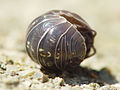 Armadillidium vulgare beginning to unroll from its defensive posture
 -
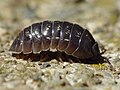
 Solid grey A. vulgare as adults
 -
 Spotted A. vulgare specimen


References
[edit]- ^ "Armadillidium vulgare". Integrated Taxonomic Information System.
- ^ a b c Helmut Schmalfuss (2003). "World catalog of terrestrial isopods (Isopoda: Oniscidea) — revised and updated version" (PDF). Stuttgarter Beiträge zur Naturkunde, Serie A. 654: 341 pp. Archived from the original (PDF) on February 24, 2009. Retrieved February 13, 2009.
- ^ a b "Pill woodlouse (Armadillidium vulgare)". ARKive.org. Archived from the original on September 3, 2009. Retrieved February 13, 2009.
- ^ "Woodlouse Wizard: an identification key". Natural History Museum. Retrieved August 20, 2014.
- ^ Hassall, Mark; Moss, Anna; Dixie, Bernice; Gilroy, James J. (December 3, 2018). "Interspecific variation in responses to microclimate by terrestrial isopods: implications in relation to climate change". ZooKeys. 801: 5–24. doi:10.3897/zookeys.801.24934. ISSN 1313-2970.
{{cite journal}}: CS1 maint: unflagged free DOI (link) - ^ Ferenţi, Sára; Cupşa, Diana; Cicort-Lucaciu, A.ş.; Covaciu-Marcov, S.D. (2013). "Winter activity of terrestrial isopods from thermal habitats in western Romania". Archives of Biological Sciences. 65 (2): 795–800. doi:10.2298/ABS1302795F. ISSN 0354-4664.
- ^ Saska, Pavel (December 2008). "Granivory in terrestrial isopods". Ecological Entomology. 33 (6): 742–747. doi:10.1111/j.1365-2311.2008.01026.x. ISSN 0307-6946.
- ^ "Other Invertebrate Pests". www.sciencedirect.com. doi:10.1016/B978-012158861-8/50014-4. Retrieved March 17, 2026.
- ^ Dias, Natália; Hassall, Mark; Waite, Tom (May 10, 2012). "The influence of microclimate on foraging and sheltering behaviours of terrestrial isopods: Implications for soil carbon dynamics under climate change". Pedobiologia. 55 (3): 137–144. doi:10.1016/j.pedobi.2011.10.003. ISSN 0031-4056.
- ^ "Other Invertebrate Pests". www.sciencedirect.com. doi:10.1016/B978-012158861-8/50014-4. Retrieved March 17, 2026.
- ^ a b c "Other Invertebrate Pests". www.sciencedirect.com. doi:10.1016/B978-012158861-8/50014-4. Retrieved March 18, 2026.
- ^ Hild, Sabine; Marti, Othmar; Ziegler, Andreas (July 1, 2008). "Spatial distribution of calcite and amorphous calcium carbonate in the cuticle of the terrestrial crustaceans Porcellio scaber and Armadillidium vulgare". Journal of Structural Biology. 163 (1): 100–108. doi:10.1016/j.jsb.2008.04.010. ISSN 1047-8477.
- ^ Hasegawa, Yuriko; Negishi, Sumiko; Naito, Junko; Ikeda, Rie; Hasegawa, Hiroyuki; Nagamura, Yoichi (August 1999). "Ommochrome Deficiency in an Albino Strain of a Terrestrial Isopod, Armadillidium vulgare". Pigment Cell Research. 12 (4): 275–282. doi:10.1111/j.1600-0749.1999.tb00761.x. ISSN 0893-5785.
- ^ a b c d e f "Armadillidium vulgare (pillbug) | INFORMATION | Animal Diversity Web". animaldiversity.org. Retrieved March 18, 2026.
- ^ Jan Frouza; Richard Lobinske; Jirí Kalcík; Arshad Ali (2008). "Effects of the exotic crustacean, Armadillidium vulgare (Isopoda), and other macrofauna on organic matter dynamics in soil microcosms in a hardwood forest in central Florida". The Florida Entomologist. 91 (2): 328–331. doi:10.1653/0015-4040(2008)91[328:EOTECA]2.0.CO;2.
- ^ Oscar H. Paris (1963). "The ecology of Armadillidium vulgare (Isopoda: Oniscoidea) in California grassland: food, enemies, and weather". Ecological Monographs. 33 (1). Ecological Society of America: 1–22. Bibcode:1963EcoM...33....1P. doi:10.2307/1948475. JSTOR 1948475.
- ^ "Armadillidium vulgare var. "Punta Cana"". Archived from the original on May 29, 2019. Retrieved May 29, 2019.
- ^ Stanley A. Schultz & Marguerite J. Schultz (2009). The Tarantula Keeper's Guide: Comprehensive Information on Care, Housing, and Feeding. Barron's Educational Series. pp. 181–183. ISBN 978-0-7641-3885-0.
- ^ a b Smith-Rogers, Sheryl (October 2009). "Wild Thing: Roly-Poly Pillbugs". TPW Magazine. Retrieved July 10, 2010.
- ^ Nielsen, Lorin (September 30, 2018). "Pill Bugs: Are They Friends Or Foes?". Epic Gardening. Retrieved March 7, 2025.
Pill bugs don't bite, nor do they sting or transmit diseases.
- ^ Marcadé, Isabelle; Cordaux, Richard; Doublet, Vincent; Debenest, Catherine; Bouchon, Didier; Raimond, Roland (December 1, 2007). "Structure and Evolution of the Atypical Mitochondrial Genome of Armadillidium vulgare (Isopoda, Crustacea)". Journal of Molecular Evolution. 65 (6): 651–659. doi:10.1007/s00239-007-9037-5. ISSN 1432-1432.
- ^ Refinetti, Roberto (1984). "Behavioral Temperature Regulation in the Pill Bug, Armadillidium vulgare (Isopoda)". Crustaceana. 47 (1): 29–43. ISSN 0011-216X.
- ^ Moriyama, Tohru (October 2004). "Problem Solving and Autonomous Behavior in Pill Bugs (Armadillidiun vulgare)". Ecological Psychology. 16 (4): 287–302. doi:10.1207/s15326969eco1604_2. ISSN 1040-7413.
- ^ Wright, Jonathan C.; O'Donnell, Michael J. (July 2010). "In Vivo Ion Fluxes across the Eggs of Armadillidium vulgare (Oniscidea: Isopoda): The Role of the Dorsal Organ". Physiological and Biochemical Zoology. 83 (4): 587–596. doi:10.1086/651583. ISSN 1522-2152.
{{cite journal}}: no-break space character in|first2=at position 8 (help); no-break space character in|first=at position 9 (help) - ^ Beauché, Fanny; Richard, Freddie-Jeanne (March 1, 2013). "The Best Timing of Mate Search in Armadillidium vulgare (Isopoda, Oniscidea)". PLOS ONE. 8 (3) e57737. doi:10.1371/journal.pone.0057737. ISSN 1932-6203. PMC 3585876. PMID 23469225.
{{cite journal}}: CS1 maint: unflagged free DOI (link)
External links
[edit] Media related to Armadillidium vulgare at Wikimedia Commons
 Data related to Armadillidium vulgare at Wikispecies


| Authority control databases: National |
|---|
