From Wikipedia
Open on Wikipedia
| Nessus sphinx | |
|---|---|
.jpg)
| |
Scientific classification 
| |
| Kingdom: | Animalia |
| Phylum: | Arthropoda |
| Clade: | Pancrustacea |
| Class: | Insecta |
| Order: | Lepidoptera |
| Family: | Sphingidae |
| Subtribe: | Macroglossina |
| Genus: | Amphion Hübner, 1819 |
| Species: | A. floridensis
|
| Binomial name | |
| Amphion floridensis B. P. Clark, 1920[1]
| |
| Synonyms | |
| |
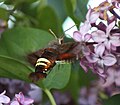
Amphion floridensis, the Nessus sphinx, is a day-flying moth of the family Sphingidae. The species was described by Pieter Cramer in 1777, and renamed in 1920. It is the only member of the genus Amphion erected by Jacob Hübner in 1819. It lives throughout the eastern United States and Canada and occasionally south into Mexico, and is one of the more commonly encountered day-flying moths in the region, easily recognized by the two bright-yellow bands across the abdomen.
Description
[edit]The Nessus sphinx has reddish median bands on its hindwings and two prominent horizontal yellow stripes and a tail feather-like hair tuft on abdomen of both sexes.[2] The wingspan is 37–55 mm.[3] It has a stout body and reddish-brown upperside wings, and in some individuals the hindwings may have pale to absent median band or a yellow spot on the costal margin.[4]
-
 Female
 -
 Female underside
 -
 Male
Male -
 Male underside


Geographic range
[edit]Found in the Eastern United States from Maine to Florida and in Nova Scotia in Canada, and as far west as Colorado.[4]
Habitat
[edit]Found in deciduous and mixed woodlands, cultivated orchards, along streams, and in suburbs with sufficient tree cover.[2][4]
Biology
[edit]Adults are on wing from April to July in one generation in the north and in two generations in the south.[5] The adults feed on the nectar of various flowers, including Syringa vulgaris, Geranium robertianum, Kolkwitzia amabilis, Philadelphus coronarius, and Phlox species.[4]
The larvae feed on Vitis, Ampelopsis, and Capsicum species.[6]
Taxonomy
[edit]It was first described as Sphinx nessus by Pieter Cramer in 1777. This name was invalid, because Dru Drury had already used it for another species (Theretra nessus) in 1773. A replacement name was published in Benjamin Preston Clark in 1920.
Images
[edit]-
 As caterpillar (top view)
 -
 As caterpillar (bottom view)
 -
 Flying on a lilac
 -
 Side view
_-_Kitchener,_Ontario_2019-07-16.jpg)


References
[edit]
- ^ "CATE Creating a Taxonomic eScience - Sphingidae". Cate-sphingidae.org. Archived from the original on 2012-11-08. Retrieved 2011-10-26.
- ^ a b "Nessus Sphinx Moth". The Wisconsin Moths Field Guide. Retrieved 2026-05-12.
- ^ "Amphion floridensis The Nessus Sphinx B. P. Clark, 1920". Sphingidae of the Americas. Archived from the original on April 9, 2015. Retrieved October 26, 2011.
- ^ a b c d "Nessus sphinx Amphion floridensis B.P. Clark, 1920 | Butterflies and Moths of North America". www.butterfliesandmoths.org. Retrieved 2026-05-12.
- ^ Bartlett, Troy (July 31, 2018). "Species Amphion floridensis - Nessus Sphinx - Hodges#7873". BugGuide. Retrieved December 3, 2018.
- ^ Lotts, Kelly & Naberhaus, Thomas (2017). "Nessus sphinx Amphion floridensis B.P. Clark, 1920". Butterflies and Moths of North America. Retrieved December 3, 2018.
 | This Macroglossini-related article is a stub. You can help Wikipedia by adding missing information. |