From Wikipedia
Open on Wikipedia
| Buddleja davidii | |
|---|---|

| |
Scientific classification 
| |
| Kingdom: | Plantae |
| Clade: | Embryophytes |
| Clade: | Tracheophytes |
| Clade: | Spermatophytes |
| Clade: | Angiosperms |
| Clade: | Eudicots |
| Clade: | Asterids |
| Order: | Lamiales |
| Family: | Scrophulariaceae |
| Genus: | Buddleja |
| Species: | B. davidii
|
| Binomial name | |
| Buddleja davidii | |
| Synonyms | |
| |
Buddleja davidii (spelling variant Buddleia davidii), also called butterfly-bush,[1] orange eye, or summer lilac, is a species of flowering plant in the family Scrophulariaceae, native to most of China except for the far northeast.[2] It is widely used as an ornamental plant, and many named cultivars are in cultivation. The genus was named Buddleja after the English botanist, Reverend Adam Buddle. The species name, davidii, is after the French missionary and explorer in China, Father Armand David, who was the first European to report the shrub.[3] It was found near Yichang by Dr Augustine Henry about 1887 and sent to St Petersburg. Another botanist-missionary in China, Jean-André Soulié, sent seed to the French nursery Vilmorin, and B. davidii entered commerce in the 1890s.[4]
B. davidii was accorded the RHS Award of Merit (AM) in 1898, and the Award of Garden Merit (AGM) in 1941.[5]
Description
[edit]Buddleja davidii is a vigorous shrub with an arching habit, growing to 5 m (16 ft) in height. The pale grey-brown bark becomes flaky to deeply fissured with age. The branches are quadrangular in section, the younger shoots and leaves covered in a dense indumentum. The opposite lanceolate leaves are 7–20 cm (3–8 inches) long and 2–7 cm (1–3 inches) broad, grey-green to dark green above, greyish-white tomentose beneath when young and becoming grey-green with age. The flowers are honey-scented, lilac to purple or occasionally white, produced in terminal panicles, usually under 20 cm (8 inches) long but can be 30 cm (12 inches) or more long.[6][7] The flowers are perfect (having both male and female parts), hence are hermaphrodite rather than monoecious (separate male and female flowers on the same plant) as is often incorrectly stated. Ploidy 2n = 76 (tetraploid).[8] The seeds are very small, and wind-dispersed.[1]
Taxonomy
[edit]In a 1979 revision of the taxonomy of the African and Asian species of Buddleja, the Dutch botanist Anthonius Leeuwenberg sank the six varieties of the species as synonyms of the type, considering them to be within the natural variation of the species, and not worthy of separate varietal recognition.[9] Leeuwenberg's taxonomy was adopted in the Flora of China[10] published in 1996, and is also upheld by both the Plants of the World Online database and the International Dendrology Society's Trees and Shrubs Online website.[2][11] However, as the distinctions of the former varieties are still accepted by some in horticulture,[6] they are listed here:
Cultivation
[edit]Buddleja davidii cultivars are widely cultivated worldwide as ornamental shrubs and for the value of their flowers as a nectar source for many species of butterfly. However, the plant does not provide food for butterfly larvae, and buddlejas might out-compete the host plants that caterpillars require.[12][13]
The species and its cultivars are not able to survive the harsh winters of northern or montane climates, being killed by temperatures below about −15 to −20 °C (5 to −4 °F).[citation needed]
Younger wood is more floriferous, so even if frosts do not kill the previous year's growth, the shrub can be hard-pruned in spring once frosts have finished, to encourage new growth. The removal of spent flower panicles may be undertaken to reduce the nuisance of self-seeding and encourage further flower production; this extends the flowering season which is otherwise limited to about six weeks, although the flowers of the second and third flushes are invariably smaller.
Hardiness: USDA zones 5–9.[14]
There are approximately 180 Buddleja davidii cultivars, as well as numerous hybrids, including with Buddleja globosa and Buddleja fallowiana grown in gardens. Some cultivars are of a dwarf habit, growing to no more than 1.5 m (5 feet).
A plant-evaluation manager at the Chicago Botanic Garden in Glencoe, Illinois (USDA Hardiness zone 5b) rated nearly 50 Buddlejia varieties and cultivars during a six-year trial period, with a summary in 2015 of the characteristics of each and the study's findings.[15] University studies have suggested that nectaring butterflies have greater preferences for some Buddleja cultivars than for others, with Lo & Behold 'Blue Chip' and 'Pink Delight' heading a list of eleven.[16]
Other notable cultivars and hybrids include 'Golden Glow' and 'Silver Frost'.[17][18]
Invasive species
[edit]
Buddleja davidii has been designated as an invasive species or a "noxious weed" in a number of countries in temperate regions, including the United Kingdom, the Republic of Ireland and New Zealand.[19] It is naturalised in Australia[20] and in many cities of central and southern Europe, where it can spread on open land, railway lines, urban areas and in gardens.
B. davidii was first documented as an invasive species in 1922, in the United Kingdom at Harlech in North Wales.[1] It is now often seen there along railway lines and on the sites of derelict factories and other walls and buildings.[21] The plant frequently grew on urban bomb sites during the aftermath of World War II, earning it the nickname of "the bomb site plant".[22]
B. davidii is widely marketed throughout the United States, where it has reportedly become invasive in some, but not all, areas within which it has been planted.[23][24][25] Although its flowers feed many native butterflies and other pollinators, plantings of the species are now controversial.[24][26][27] To prevent seeding and to promote further flowering, its blossoms need to be removed ("deadheaded") as soon as they are spent.[23]
"Non-invasive" Buddleja cultivars
[edit]A number of Buddleja cultivars have become available that have a variety of sizes and flower colours and that are either sterile or produce less than 2% viable seed.[23][26][28][29] The northwestern U.S. state of Oregon, which designated B. davidii as a "noxious weed" and initially prohibited entry, transport, purchase, sale or propagation of all of its varieties, amended its quarantine in 2009 to permit those cultivars when approved or when proven to be interspecific hybrids.[23][26][28][30] The adjacent state of Washington has taken actions that are similar to those of Oregon to bring parity to nursery sales between the two states.[31]
Dennis J. Werner developed the "Lo and Behold" Buddleja hybrid series and the 'Miss Ruby' and 'Miss Violet' Buddleja hybrids at North Carolina State University's JC Raulston Arboretum in Raleigh and at the university's Sandhills Research Station in Jackson Springs.[32] He selected most of the hybrids to have a very low seed-set and to be non-invasive.[33] Members of the "Lo and Behold" series vary from 30 centimetres (11.8 in) in spread and height to about 1.5 metres (4.9 ft) in height.[33]
Werner introduced the first of the cultivars (Blue Chip) around 2008.[33] He derived several of the more recent introductions from his earlier hybrids.[33] While some, such as "Lo and Behold" 'Blue Chip Jr', 'Ice Chip', 'Lilac Chip' and 'Pink Micro Chip', produce no viable pollen and are highly female-sterile,[34] the plants are not necessarily fully sterile.[33] Most were still available in 2022.[33]
Peter Podaras developed the "Flutterby" Buddleja series during the 2000s while at Cornell University's Department of Horticulture in Ithaca, New York and patented them in 2011. Podaras selected each of the cultivars for their sterility or low fertility. Although innovative when introduced, several members of the series are no longer commercially available and are rare in cultivation.[35] Monarch Watch recommends planting only male-sterile "Flutterby" cultivars.[36]
Vendors have marketed the following "non-invasive" Buddleja cultivars:
|
|
|
Gallery
[edit]-
 Monarch butterfly feeding on a Buddleja flower, Connecticut, United States
 -
 Buddleja davidii flowers with painted lady, peacock and (underneath) small tortoiseshell butterflies
 -
 A snowberry clearwing moth carrying pollen on its proboscis while hovering at a Buddleja blossom
 -
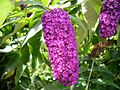 Close-up of purple Buddleja davidii cultivar flowers
 -
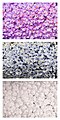 Close-up of purple Buddleja davidii flowers photographed in visible, ultraviolet, and infrared light
 -
 Buddleja davidii 'White Profusion' cultivar flowers
 -
 Seed capsules
 -
 Seeds
Seeds -
 Leaves


_Vis_UV_IR_comparison.jpg)


See also
[edit]- Index: Buddleja — for Buddleja davidii cultivars.
References
[edit]- ^ a b c "Butterfly-bush Buddleja davidii Franch". PlantAtlas. Retrieved 2025-12-09.
- ^ a b "Buddleja davidii Franch". Plants of the World Online. 2020-09-11. Retrieved 2025-12-09.
- ^ "Buddleja davidii - Plant Finder". www.missouribotanicalgarden.org. Retrieved 2021-02-18.
- ^ Alice M. Coats, Garden Shrubs and Their Histories (1964) 1992, s.v. "Buddleia"
- ^ Hillier & Sons. (1990). Hillier's Manual of Trees & Shrubs, 5th ed.. p. 47. David & Charles, Newton Abbot. ISBN 0-7153-67447
- ^ a b Huxley, Anthony (1992). Royal Horticultural Society Dictionary of Gardening. Vol. 1. London New York: Macmillan Stockton press. p. 411. ISBN 1-56159-001-0.
- ^ Stuart, D. (2006). Buddlejas. pp 30–34. RHS Plant Collector Series, Timber Press, Oregon. ISBN 978-0-88192-688-0
- ^ Chen, G; Sun, W-B; Sun, H (2007). "Ploidy variation in Buddleja L. (Buddlejaceae) in the Sino - Himalayan region and its biogeographical implications". Botanical Journal of the Linnean Society. 154 (3): 305–312. doi:10.1111/j.1095-8339.2007.00650.x.
- ^ Leeuwenberg, A. J. M. (1979). "The Loganiaceae of Africa XVIII Buddleja L. II, Revision of the African & Asiatic species". H. Veenman & Zonen B. V., Wageningen, Nederland. Retrieved 2025-12-13.
- ^ Li, P-T. & Leeuwenberg, A. J. M. (1996). Loganiaceae, in Wu, Z. & Raven, P. (eds) Flora of China, Vol. 15. Science Press, Beijing, and Missouri Botanical Garden Press, St. Louis, USA. ISBN 978-0915279371 online at www.efloras.org
- ^ "Buddleja davidii". Trees and Shrubs Online. 2025-12-08. Retrieved 2025-12-09.
- ^ Zerbe, Leah (2018-06-18). "Why You Should Never Plant a Butterfly Bush Again". Good Housekeeping. Hearst Media. Retrieved 2019-10-23.
- ^ Gupta, Tanya (2014-07-15). "Buddleia: The plant that dominates Britain's railways". BBC News. British Broadcasting Corporation. Retrieved 2019-10-23.
- ^ Stuart, D. D. (2006). Buddlejas. pp. 119–120. RHS Plant Guide. Timber Press, Oregon. ISBN 978-0-88192-688-0
- ^ Hawke, Richard (August 2015). "Beyond the basic Butterfly Bush: Plant Trial Results" (PDF). Fine Gardening. Newtown, Connecticut: Taunton Press. pp. 31–36. Archived (PDF) from the original on 21 April 2016. Retrieved 13 August 2021.
- ^ "Buddleia" (PDF). New Brunswick, New Jersey: New Jersey Agricultural Experiment Station: Rutgers Office of Continuing Education. Archived (PDF) from the original on 15 August 2021. Retrieved 15 August 2021.
- ^ Moore, Raymond J. (June 1960). "Cyto-Taxonomic Notes on Buddleia". American Journal of Botany. 47 (6): 511–517. doi:10.1002/j.1537-2197.1960.tb10621.x.
- ^ "Buddleja 'Silver Frost' - Trees and Shrubs Online". treesandshrubsonline.org. Retrieved 2021-12-04.
- ^ Multiple sources:
- "Buddleja davidii (butterfly bush)". Invasive Species Compendium. Wallingford, Oxfordshire, England: Centre for Agriculture and Bioscience International. 2021. Archived from the original on 13 August 2021. Retrieved 13 August 2021.Dhuill, E.N.; Smyth, N. (2021). "Invasive non-native and alien garden escape plant species on the southern cliffs of Howth, Co. Dublin (H21)". Irish Naturalists. 37 (2): 102–108.
- Tallent-Halsell, Nita G.; Watt, Michael S. (September 2009). "The Invasive Buddleja davidii (Butterfly Bush)". Botanical Review. 75 (3). New York: Springer: 292–325. Bibcode:2009BotRv..75..292T. doi:10.1007/s12229-009-9033-0. JSTOR 40389400. S2CID 46039523. Archived from the original on 13 August 2021. Retrieved 13 August 2021 – via ResearchGate.
- ^ "Buddleja davidii". Australian Plant Name Index (APNI). Centre for Plant Biodiversity Research, Australian Government. Retrieved 3 April 2023.
- ^ Gupta, Tanya (15 July 2014). "Buddleia: The plant that dominates Britain's railways". BBC News. Archived from the original on 8 April 2020. Retrieved 5 July 2021.
- ^ Moynihan, Jonathan. "Flower of the Week: Butterfly Bush". Patch. Edgewater-Davisonville, Maryland. Archived from the original on 7 August 2021. Retrieved 7 August 2021.
These popular garden flowers can even survive in post-war circumstances, earning the name, "the bomb site plant".
- ^ a b c d Young-Mathews, Ann (2011). "Plant fact sheet for orange eye butterflybush (Buddleja davidii)" (PDF). Corvallis, Oregon: United States Department of Agriculture: Natural Resources Conservation Service: Corvallis Plant Materials Center. Archived (PDF) from the original on 4 August 2021. Retrieved 4 August 2021.
- ^ a b Hurwitz, Jane, ed. (Summer 2012). "The Great Butterfly Bush Debate" (PDF). Butterfly Gardener. 7 (2). North American Butterfly Association. Archived (PDF) from the original on 22 July 2021. Retrieved 4 August 2021.
- ^ Multiple sources:
- "butterflybush: Buddleja davidii Franch". Invasive Plant Atlas Of The United States. October 2018. Archived from the original on 28 April 2021. Retrieved 5 August 2021.
- Brusati, Elizabeth D. (21 June 2016). "Buddleja davidii Risk Assessment". Berkeley, California: California Invasive Plant Council. Archived from the original on 22 January 2021. Retrieved 18 August 2021.
- ^ a b c Hadley, Debbie (26 August 2020). "Pros and Cons of Planting Butterfly Bush". ThoughtCo. Archived from the original on 26 February 2021. Retrieved 4 August 2021.
- ^ Marazzi, Brigitte; De Micheli, Andrea (2019). "Are sterile Buddleja cultivars really sterile and "environmentally safe"?" (PDF). Bollettino della Società ticinese di scienze naturali. 107: 55–60. ISSN 0379-1254. OCLC 611282784. Archived (PDF) from the original on 13 August 2021. Retrieved 13 August 2021.
- ^ a b c d e f g h i j k l m n o p q r s "Butterfly Bush Approved Cultivars". Oregon Department of Agriculture. Archived from the original on 7 October 2014. Retrieved 6 August 2021.
- ^ Bender, Steve (26 July 2015). "Not Your Mama's Butterfly Bush". Southern Living. Birmingham, Alabama: Southern Progress Corporation. ISSN 0038-4305. OCLC 2457928. Archived from the original on 26 February 2021. Retrieved 6 August 2021.
- ^ Multiple sources:
- "Noxious Weed Pest Risk Assessment for Butterfly Bush: Buddleja davidii: Buddlejaceae" (PDF). Plant Pest Risk Assessment. Salem, Oregon: Oregon Department of Agriculture: Noxious Weed Control Program. March 2016. Archived (PDF) from the original on 6 July 2017. Retrieved 4 August 2021.
- Altland, James (January 2005). "How to keep butterfly bush from spreading noxiously". Oregon State University Extension Service. Archived from the original on 20 May 2021. Retrieved 4 August 2021.
- ^ Multiple sources:
- "Butterfly Bush: Buddleja davidii". Olympia, Washington: Washington State Noxious Weed Control Board. Archived from the original on 18 July 2021. Retrieved 13 August 2021.
- "Washington Administrative Code: Title 16: Section 16-752-610 (WAC 16-752-610). Regulated Articles". Olympia, Washington: Washington State Legislature. Archived from the original on 10 April 2021. Retrieved 13 August 2021.
Buddleia davidii: butterfly bush (except accepted sterile cultivars)
- ^ Multiple sources:
- "Dennis Werner". Horticultural Science. Raleigh, North Carolina: NC State University. Archived from the original on 23 September 2023. Retrieved 16 February 2023.
- Werner, Dennis J.; Snelling, Layne K. (2011). "'Purple Haze', 'Miss Molly', and 'Ice Chip' Buddleja". HortScience. 46 (9). Alexandria, Virginia: American Society for Horticultural Science: 1330–1332. doi:10.21273/HORTSCI.46.9.1330. ISSN 2327-9834. LCCN 85644626. OCLC 768085913. Archived from the original on 10 August 2021. Retrieved 10 August 2021.
- "Buddleja 'Blue Chip' Lo and Behold". Plant Finder. St. Louis: Missouri Botanical Garden. Archived from the original on 15 February 2024. Retrieved 15 February 2024.
- "Buddleja plant named 'Blue Chip'". Google Patents. USPP19991P3. Archived from the original on 7 August 2021. Retrieved 7 August 2021.
- "Buddleja plant named 'Blue Chip Jr'". Google Patents. USPP26581P3. Archived from the original on 10 August 2021. Retrieved 10 August 2021.
- "Buddleja plant named 'Ice Chip'". Google Patents. USPP24015P3. Archived from the original on 7 August 2021. Retrieved 7 August 2021.
- "Buddleja plant named 'Lilac Chip'". Google Patents. USPP24016P3. Archived from the original on 11 August 2021. Retrieved 11 August 2021.
- "Buddleja plant named 'Pink Micro Chip'". Google Patents. USPP26547P3. Archived from the original on 11 August 2021. Retrieved 11 August 2021.
- "Buddleja plant named 'Miss Ruby'". Google Patents. USPP19950P3. Archived from the original on 14 August 2021. Retrieved 14 August 2021.
- "Buddleja plant named 'Miss Violet'". Google Patents. USPP28448P3. Archived from the original on 18 August 2021. Retrieved 18 August 2021.
- "Sandhills Research Station". Jackson Springs, North Carolina: North Carolina State University College of Agriculture and Life Sciences. Archived from the original on 4 October 2023. Retrieved 15 February 2024.
- ^ a b c d e f "The Lo and Behold® Buddleja Hybrids". The Buddleja Garden. July 2022. Archived from the original on 5 December 2023. Retrieved 15 February 2024.
- ^ Multiple sources:
- Werner, Dennis J.; Snelling, Layne K. (2011). "'Purple Haze', 'Miss Molly', and 'Ice Chip' Buddleja". HortScience. 46 (9). Alexandria, Virginia: American Society for Horticultural Science: 1330–1332. doi:10.21273/HORTSCI.46.9.1330. ISSN 2327-9834. LCCN 85644626. OCLC 768085913. Archived from the original on 10 August 2021. Retrieved 10 August 2021.
- "Buddleja plant named 'Blue Chip Jr'". Google Patents. USPP26581P3. Archived from the original on 10 August 2021. Retrieved 10 August 2021.
- "Buddleja plant named 'Ice Chip'". Google Patents. USPP24015P3. Archived from the original on 7 August 2021. Retrieved 7 August 2021.
- "Buddleja plant named 'Lilac Chip'". Google Patents. USPP24016P3. Archived from the original on 11 August 2021. Retrieved 11 August 2021.
- "Buddleja plant named 'Pink Micro Chip'". Google Patents. USPP26547P3. Archived from the original on 11 August 2021. Retrieved 11 August 2021.
- ^ Large, Andrew (2021). "Buddleja FLUTTERBY™ Series". Trees and Shrubs Online. International Dendrology Society. Archived from the original on 2 October 2023. Retrieved 14 February 2024.
- ^ "Plants For Butterfly And Pollinator Gardens: Native and Non-native Plants Suitable for Gardens in the Northeastern United States" (PDF). Monarch Watch. Archived (PDF) from the original on 28 October 2020. Retrieved 4 August 2021.
- ^ Multiple sources:
- Renfro, Scott E.; Burkett, Brent M.; Dunn, Bruce L.; Lindstrom, Jon T. (October 2007). "'Asian Moon' Buddleja". HortScience. 42 (6). Alexandria, Virginia: American Society for Horticultural Science: 1486–1487. doi:10.21273/HORTSCI.42.6.1486. Archived from the original on 15 August 2021. Retrieved 15 August 2021.
- "Buddleja 'Asian Moon'". Plant Finder. St. Louis: Missouri Botanical Garden. Archived from the original on 15 February 2024. Retrieved 15 February 2024.
- "Asian Moon Summer Lilac". Azusa, California: Monrovia Nursery Company. 2021. Archived from the original on 6 August 2021. Retrieved 6 August 2021.
- "Fragrant, Long-blooming, Asian Moon Butterfly Bush is Sterile". Park Hill, Oklahoma: Greenleaf Nursery Company. 2021. Archived from the original on 15 August 2021. Retrieved 15 August 2021.
- "Asian Moon Butterfly Bush: Buddleia x 'Asian Moon'". Garden Debut. Park Hill, Oklahoma: Greenleaf Nursery Company. Archived from the original on 15 June 2019. Retrieved 13 October 2021.
- "Asian Moon Sterile Butterfly Bush: Buddleia davidii 'Asian Moon'". Green County, Northeast Oklahoma: Sooner Plant Farm. Archived from the original on 13 October 2021. Retrieved 13 October 2020.
- ^ Multiple sources:
- "Buddleja plant named 'Podaras #12'". Google Patents. USPP22098P2. Archived from the original on 8 August 2021. Retrieved 8 August 2021.
- "Buddleia Flutterby Flow® Lavendar". Ball Seed: Plant Information. West Chicago, Illinois: Ball Horticultural Company. 17 August 2021. Archived from the original on 8 August 2021. Retrieved 15 February 2024.
- "Flutterby Flow® Lavender". Hardy Hybrids. Longstock, Hampshire, England: Longstock Park Nursery: National Plant Collection: The Buddleia National Collection. 2016. Accession Number B231. Archived from the original on 30 September 2023. Retrieved 15 February 2024.
- ^ Multiple sources:
- "Buddleja plant named 'Podaras #7'". Google Patents. USPP22110P2. Archived from the original on 8 August 2021. Retrieved 8 August 2021.
- "Buddleia Flutterby Flow® Mauve Pink". Ball Seed: Plant Information. West Chicago, Illinois: Ball Horticultural Company. 17 August 2021. Archived from the original on 8 August 2021. Retrieved 17 August 2021.
- ^ Multiple sources:
- "Buddleja plant named 'Podaras #4'". Google Patents. USPP22109P2. Archived from the original on 8 August 2021. Retrieved 8 August 2021.
- "Flutterby Grande Blueberry Cobbler". Ball Seed: Plant Information. West Chicago, Illinois: Ball Horticultural Company. 17 August 2021. Archived from the original on 6 August 2021. Retrieved 17 August 2021.
- "Fluttery Grande® Blueberry Cobbler Butterfly Bush: Buddleia x 'Blueberry Cobbler'". Green County, Northeast Oklahoma: Sooner Plant Farm. Archived from the original on 6 March 2021. Retrieved 13 October 2020.
- ^ Multiple sources:
- "Buddleja plant named 'Podaras #5'". Google Patents. 13 September 2011. USPP22144P2. Archived from the original on 7 August 2021. Retrieved 7 August 2021.
- "Flutterby Grande® Peach Cobbler". Ball Seed: Plant Information. West Chicago, Illinois: Ball Horticultural Company. 17 August 2021. Archived from the original on 6 August 2021. Retrieved 17 August 2021.
- ^ Multiple sources:
- "Buddleja plant named 'Podaras #2'". Google Patents. 17 August 2021. USPP22109P2. Archived from the original on 8 August 2021. Retrieved 17 August 2021.
- "Flutterby Grande® Sweet Marmalade". Ball Seed: Plant Information. West Chicago, Illinois: Ball Horticultural Company. 17 August 2021. Archived from the original on 6 August 2021. Retrieved 17 August 2021.
- ^ Multiple sources:
- "Buddleja plant named 'Podaras #3'". Google Patents. USPP22081P2. Archived from the original on 17 August 2021. Retrieved 17 August 2021.
- "Flutterby Grande® Tangerine Dream". Ball Seed: Plant Information. West Chicago, Illinois: Ball Horticultural Company. 17 August 2021. Archived from the original on 6 August 2021. Retrieved 6 August 2021.
- ^ Multiple sources:
- "Buddleja plant named 'Podaras #1'". Google Patents. USPP22080P2. Archived from the original on 17 August 2021. Retrieved 17 August 2021.
- "Flutterby Grande® Vanilla Butterfly Bush: Buddleia x 'Vanilla'". Keys, Oklahoma: Sooner Plant Farm, Inc. 2021. Archived from the original on 17 August 2021. Retrieved 17 August 2021.
- "Flutterby Grande® Vanilla". Ball Seed: Plant Information. West Chicago, Illinois: Ball Horticultural Company. 17 August 2021. Archived from the original on 6 August 2021. Retrieved 17 August 2021.
- ^ Multiple sources:
- "Buddleja plant named 'Podaras #11'". Google Patents. USPP22067P2. Archived from the original on 9 August 2021. Retrieved 7 August 2021.
- "Flutterby® Lavender (Nectar Bush)". Ball Seed: Plant Information. West Chicago, Illinois: Ball Horticultural Company. 17 August 2021. Archived from the original on 6 August 2021. Retrieved 17 August 2021.
- "Flutterby® Lavender". Hardy Hybrids. Longstock, Hampshire, England: Longstock Park Nursery: National Plant Collection: The Buddleia National Collection. 2016. Accession Number B187. Archived from the original on 17 January 2021. Retrieved 9 August 2021.
- ^ Multiple sources:
- "Buddleja plant named 'Podaras #6'". Google Patents. USPP22142P2. Archived from the original on 9 August 2021. Retrieved 9 August 2021.
- "Buddleia Flutterby® Peace". Ball Seed: Plant Information. West Chicago, Illinois: Ball Horticultural Company. 17 August 2021. Archived from the original on 6 August 2021. Retrieved 17 August 2021.
- ^ Multiple sources:
- "Buddleja plant named 'Podaras #8'". Google Patents. USPP22069P2. Archived from the original on 17 August 2021. Retrieved 17 August 2021.
- "Flutterby Petite® Blue Heaven Butterfly Bush". Azusa, California: Monrovia Nursery Company. 2021. Archived from the original on 6 August 2021. Retrieved 6 August 2021.
- "Free Petite® Blue Heaven". Hardy Hybrids. Longstock, Hampshire, England: Longstock Park Nursery: National Plant Collection: The Buddleia National Collection. Accession Number B208. Archived from the original on 18 January 2021. Retrieved 10 August 2021.
- ^ Multiple sources:
- "Buddleja plant named 'Podaras #10'". Google Patents. USPP22066P2. Retrieved 8 August 2021.
- "Butterfly Bush (Buddleja Flutterby Petite™ Dark Pink)". Plants Database. The National Gardening Association (garden.org). 2024. Archived from the original on 12 March 2019. Retrieved 16 February 2024.
- "Flutterby Petite® Dark Pink Butterfly Bush: Buddleia davidii 'Podaras #10'". Hopkinton, Massachusetts: Weston Nurseries. Archived from the original on 2 March 2021. Retrieved 8 August 2021.
- ^ "Buddleja plant named 'Podaras #14'". Google Patents. USPP22367P2. Archived from the original on 8 August 2021. Retrieved 8 August 2021.
- ^ Multiple sources:
- "Buddleja plant named 'Podaras #16'". Google Patents. USPP22108P2. Archived from the original on 8 August 2021. Retrieved 8 August 2021.
- "Butterfly Bush (Buddleja Flutterby Petite™ Pink)". Plants Database. The National Gardening Association (garden.org). 2021. Archived from the original on 12 March 2019. Retrieved 15 February 2024.
- "Flutterby Petite® Pink Butterfly Bush". Azusa, California: Monrovia Nursery Company. 2021. Archived from the original on 11 April 2021. Retrieved 8 August 2021.
- ^ Multiple sources:
- "Buddleja plant named 'Podaras #15'". Google Patents. USPP22143P2. Archived from the original on 7 August 2021. Retrieved 7 August 2021.
- "Butterfly Bush (Buddleja Flutterby Petite™ Snow White)". Plants Database. The National Gardening Association (garden.org). 2021. Archived from the original on 12 March 2019. Retrieved 16 August 2021.
- "Flutterby Petite® Snow White Butterfly Bush". Azusa, California: Monrovia Nursery Company. 2021. Archived from the original on 6 August 2021. Retrieved 6 August 2021.
- ^ Multiple sources:
- "Buddleja plant named 'Podaras #9'". Google Patents. USPP22065P2. Archived from the original on 7 August 2021. Retrieved 7 August 2021.
- "Buddleia Flutterby® Pink". Ball Seed: Plant Information. West Chicago, Illinois: Ball Horticultural Company. 17 August 2021. Retrieved 17 August 2021.
- ^ Multiple sources:
- "Buddleja plant named 'Podaras #13'". Google Patents. USPP22177P2. Archived from the original on 7 August 2021. Retrieved 7 August 2021.
- "Flutterby Petite® Tutti Fruitti Pink Butterfly Bush". Azusa, California: Monrovia Nursery Company. 2021. Archived from the original on 6 August 2021. Retrieved 6 August 2021.|
- "Butterfly Bush (Buddleja Flutterby Petite™ Tutti Fruitti Pink)". Plants Database. National Gardening Association (garden.org). 2024. Archived from the original on 18 January 2022. Retrieved 15 February 2024.
- ^ Multiple sources:
- "Buddleja plant named 'Pink Pagoda'". Google Patents. USPP23214P2. Archived from the original on 16 February 2024. Retrieved 16 February 2024.
- "Butterfly Bush (Buddleja InSpired™ Pink)". Plants Database. National Gardening Association (garden.org). 2024. Archived from the original on 26 November 2022. Retrieved 15 February 2024.
- "Buddleia Inspired Pink® ('Pink Pagoda')". Lebanon, Connecticut: Prides Corner Farms. 2021. Retrieved 6 August 2021.
- ^ Multiple sources:
- "Buddleja plant named 'Blue Chip'". Google Patents. USPP19991P3. Archived from the original on 7 August 2021. Retrieved 7 August 2021.
- "Buddleja Lo & Behold® 'Blue Chip'". Raleigh, North Carolina: North Carolina State University College of Agriculture and Life Sciences: North Carolina Cooperative Extension Service. Archived from the original on 11 August 2021. Retrieved 11 August 2021.
- "Buddleja 'Blue Chip' Lo and Behold". Plant Finder. St. Louis: Missouri Botanical Garden. Archived from the original on 15 February 2024. Retrieved 15 February 2024.
- "Lo & Behold® 'Blue Chip' Butterfly Bush: Buddleia x". DeKalb, Illinois: Proven Winners North America LLC. 2021. Archived from the original on 26 January 2021. Retrieved 6 August 2021.
- ^ Multiple sources:
- "Buddleja plant named 'Blue Chip Jr'". Google Patents. USPP26581P3. Archived from the original on 10 August 2021. Retrieved 10 August 2021.
- "Buddleja Lo & Behold® 'Blue Chip Jr.'". Raleigh, North Carolina: North Carolina State University College of Agriculture and Life Sciences: North Carolina Cooperative Extension Service. Archived from the original on 5 March 2021. Retrieved 10 August 2021.
- "Lo & Behold® 'Blue Chip Jr.' Butterfly Bush: Buddleia x". DeKalb, Illinois: Proven Winners North America LLC. 2021. Archived from the original on 24 January 2021. Retrieved 6 August 2021.
- ^ Multiple sources:
- "Buddleja plant named 'Ice Chip'". Google Patents. USPP24015P3. Archived from the original on 7 August 2021. Retrieved 7 August 2021.
- "Buddleja Lo & Behold® 'Ice Chip'". Raleigh, North Carolina: North Carolina State University College of Agriculture and Life Sciences: North Carolina Cooperative Extension Service. Archived from the original on 16 January 2021. Retrieved 10 August 2021.
- Werner, Dennis J.; Snelling, Layne K. (2011). "'Purple Haze', 'Miss Molly', and 'Ice Chip' Buddleja". HortScience. 46 (9). Alexandria, Virginia: American Society for Horticultural Science: 1330–1332. doi:10.21273/HORTSCI.46.9.1330. ISSN 2327-9834. LCCN 85644626. OCLC 768085913. Archived from the original on 10 August 2021. Retrieved 10 August 2021.
- "Lo & Behold® 'Ice Chip' Butterfly Bush: Buddleia x". DeKalb, Illinois: Proven Winners North America LLC. 2021. Archived from the original on 24 January 2021. Retrieved 6 August 2021.
- ^ Multiple sources:
- "Buddleja plant named 'Lilac Chip'". Google Patents. USPP24016P3. Archived from the original on 11 August 2021. Retrieved 11 August 2021.
- "Buddleja Lo & Behold® 'Lilac Chip'". Raleigh, North Carolina: North Carolina State University College of Agriculture and Life Sciences: North Carolina Cooperative Extension Service. Archived from the original on 11 August 2021. Retrieved 11 August 2021.
- "Lo & Behold® 'Lilac Chip' Butterfly Bush: Buddleia x". DeKalb, Illinois: Proven Winners North America LLC. 2021. Archived from the original on 24 January 2021. Retrieved 6 August 2021.
- ^ Multiple sources:
- "Buddleja plant named 'Pink Micro Chip'". Google Patents. USPP26547P3. Archived from the original on 11 August 2021. Retrieved 11 August 2021.
- "Buddleja Lo & Behold® 'Pink Micro Chip'". Raleigh, North Carolina: North Carolina State University College of Agriculture and Life Sciences: North Carolina Cooperative Extension Service. Archived from the original on 11 August 2021. Retrieved 11 August 2021.
- "Lo & Behold® 'Pink Micro Chip' Butterfly Bush: Buddleia x". DeKalb, Illinois: Proven Winners North America LLC. 2021. Archived from the original on 4 March 2021. Retrieved 6 August 2021.
- ^ Multiple sources:
- "Buddleja plant named 'Purple Haze'". Google Patents. USPP24514P2. Archived from the original on 12 August 2021. Retrieved 12 August 2021.
- "Buddleja Lo & Behold® 'Purple Haze'". Raleigh, North Carolina: North Carolina State University College of Agriculture and Life Sciences: North Carolina Cooperative Extension Service. Archived from the original on 7 March 2021. Retrieved 12 August 2021.
- Werner, Dennis J.; Snelling, Layne K. (2011). "'Purple Haze', 'Miss Molly', and 'Ice Chip' Buddleja". HortScience. 46 (9). Alexandria, Virginia: American Society for Horticultural Science: 1330–1332. doi:10.21273/HORTSCI.46.9.1330. ISSN 2327-9834. LCCN 85644626. OCLC 768085913. Archived from the original on 10 August 2021. Retrieved 10 August 2021.
- "Lo & Behold® 'Purple Haze' Butterfly Bush: Buddleia x". DeKalb, Illinois: Proven Winners North America LLC. 2021. Archived from the original on 26 January 2021. Retrieved 6 August 2021.
- ^ Multiple sources:
- "Buddleja plant named 'Miss Ruby'". Google Patents. USPP19950P3. Archived from the original on 14 August 2021. Retrieved 14 August 2021.
- "Buddleja 'Miss Ruby'". Raleigh, North Carolina: North Carolina State University College of Agriculture and Life Sciences: North Carolina Cooperative Extension Service. Archived from the original on 26 February 2021. Retrieved 14 August 2021.
- Werner, Dennis J.; Snelling, Layne K. (2009). "'Blue Chip' and 'Miss Ruby'". HortScience. 44 (3). Alexandria, Virginia: American Society for Horticultural Science: 841–842. doi:10.21273/HORTSCI.44.3.841. ISSN 2327-9834. LCCN 85644626. OCLC 768085913. Archived from the original on 10 August 2021. Retrieved 10 August 2021.
- "'Miss Ruby' Butterfly Bush: Buddleia x". Proven Winners North America LLC. 2021. Archived from the original on 18 January 2021. Retrieved 6 August 2021.
- ^ Multiple sources:
- "Buddleja plant named 'Miss Violet'". Google Patents. USPP28448P3. Archived from the original on 18 August 2021. Retrieved 18 August 2021.
- "Butterfly Bush (Buddleja 'Miss Violet')". Plants Database. The National Gardening Association (garden.org). 2024. Archived from the original on 12 March 2019. Retrieved 16 February 2024.
- "Buddleja 'Miss Violet'". Plant Finder. St. Louis: Missouri Botanical Garden. Archived from the original on 15 February 2024. Retrieved 15 February 2024.
- "'Miss Violet' Butterfly bush: Buddleia x". DeKalb, Illinois: Proven Winners North America LLC. 2021. Archived from the original on 29 June 2021. Retrieved 6 August 2021.
- Van Laere K (2008) Interspecific hybridisation in woody ornamentals. PhD. Thesis, Faculty of Bioscience Engineering, Ghent University
- Christenhusz, M.J.M. (2009). "Typification of ornamental plants: Buddleja davidii (Scrophulariaceae)". Phytotaxa. 2: 55. doi:10.11646/phytotaxa.2.1.11.
- Franchet, M.A. (1887). Plantae Davidianae ex sinarum imperio, part 2 "Plantes du Thibet Oriental (Province de Moupine)". (Nouvelles Archives du Museum d'Histoire Naturelle Paris), ser. 2, 10: 33-198.
- Li, P. T. & Leeuwenberg, A. J. M. (1996). Loganiaceae, in Wu, Z. & Raven, P. (eds) Flora of China, Vol. 15. Science Press, Beijing, and Missouri Botanical Garden Press, St. Louis, USA. ISBN 978-0915279371 online at www.efloras.org
External links
[edit]
- Floridata: Buddleja davidii
- BBC Gardening: Buddleja davidii
- Pacific Island Ecosystems at Risk (PIER): Buddleja davidii
- RHS Buddleja Trials Report
| International | |
|---|---|
| National | |
| Other | |
