From Wikipedia
Open on Wikipedia
| Clintonia borealis | |
|---|---|

| |
| Growing on Mont Tremblant, Quebec | |
Scientific classification 
| |
| Kingdom: | Plantae |
| Clade: | Tracheophytes |
| Clade: | Angiosperms |
| Clade: | Monocots |
| Order: | Liliales |
| Family: | Liliaceae |
| Subfamily: | Lilioideae |
| Genus: | Clintonia |
| Species: | C. borealis
|
| Binomial name | |
| Clintonia borealis | |
| Synonyms[2] | |
|
Synonymy
| |

Clintonia borealis is a species of flowering plant in the lily family. The specific epithet borealis means "of the north," which alludes to the fact that the species tends to thrive in the boreal forests of eastern Canada and northeastern United States.[3] It is commonly known as bluebead, blue bead-lily, or yellow clintonia.
Description
[edit]Clintonia borealis is a small (5–10 in) perennial plant, usually found in homogeneous colonies. At full growth, a shoot has 2–4 clasping and curved, slightly succulent leaves with parallel venation. The flowers are arranged in small umbels at the extremity of a long stalk. They have 6 stamens and 6 yellow tepals (i.e. very similar sepals and petals). In rare cases more than one umbel is found on a shoot or shoots from a clone. The fruits are small dark blue, lurid berries, which are semi-poisonous.[4] A white-berried form (f. albicarpa) also exists.[5][6]
The plant reproduces via seed or vegetatively by underground rhizomes. By either method, the plants are slow to spread. One colony often covers several hundred square meters.[7]
-
 Flowering in habitat, Mille-Isles, Quebec
 -
 Fruiting in habitat, Mille-Isles, Quebec
 -
 Fruits
.jpg)
.jpg)

Taxonomy
[edit]In 1789, William Aiton described the species Dracaena borealis Aiton,[8] a name that was to become a synonym for Clintonia borealis (Aiton) Raf. The latter was first described by Constantine Samuel Rafinesque in 1832.[9] Rafinesque also described the genus Clintonia in 1818.[10] The species C. borealis was previously classified within the genus Convallaria.[11]
Names
[edit]The name bluebead is used as the common name for Clintonia borealis by the USDA Natural Resources Conservation Service,[7] but the Database of Vascular Plants of Canada (VASCAN) prefers yellow clintonia.[12] Other common names include blue bead-lily and corn-lily.[13] The term 'bluebead' refers to the plant's quite toxic small blue spherical fruits, a quite striking feature.[14] Though the name corn-lily is well known, it is also used as a common name for many other plants.[15] (See Corn lily) Likewise, though it is occasionally called poisonberry or snakeberry many other species are also known as this.[16][17] (See Poisonberry and Snakeberry) Other names include Clinton's lily,[18] yellow bead lily,[19] and yellow bluebead-lily.[20]
Regionally, in the southern United States it is called balsam-bell. In state of New Hampshire it is called bear-plum and Canada-mayflower. In both Maine and Massachusetts it is wild lily-of the valley and dragoness-plant and heal-all in Massachusetts and New Brunswick. The greatest number of common names is in Maine where it is known as bear-tongue, bear's corn, calf-corn, dogberry, hound's-tongue, northern-lily, and wild-corn. Additionally it is cow-tongue in Maine and New Brunswick.[21]
Distribution
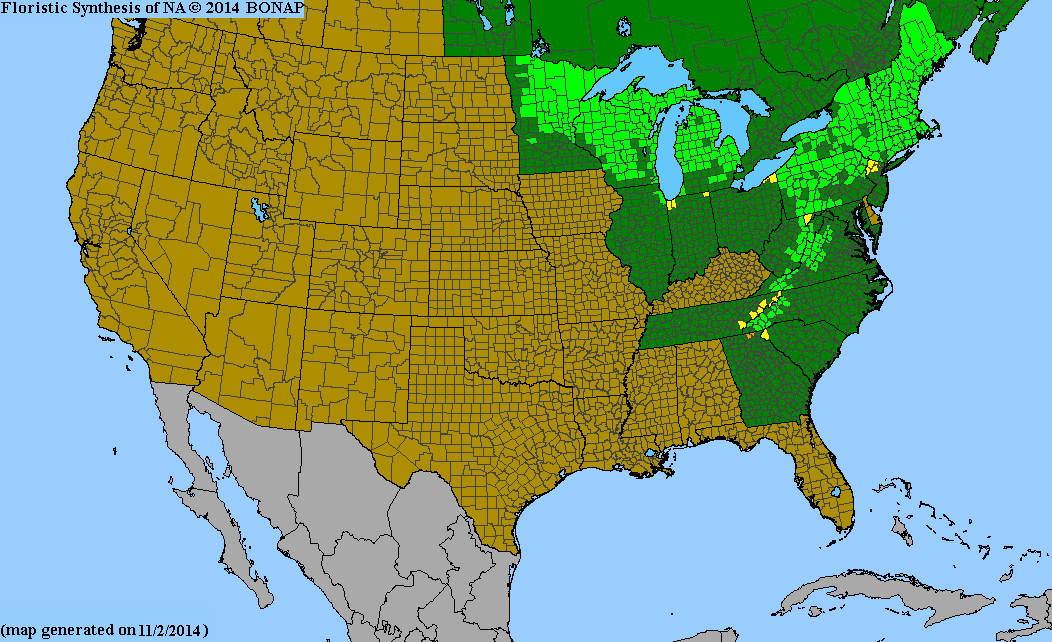
[edit]Clintonia borealis is a wide-ranging species in eastern North America, from Newfoundland and Labrador across New England into the Great Lakes region west to Manitoba and Minnesota.[2][22] Its range extends southward into the Appalachian Mountains where it is allopatric with C. umbellulata, that is, the ranges of the two species do not significantly overlap but are immediately adjacent to one another. In the Appalachians, C. umbellulata prefers hardwood forests less than 1,000 m (3,281 ft) while C. borealis populates coniferous or mixed forests up to 1,600 m (5,249 ft).[13][23]
C. borealis is globally secure but threatened in Maryland and Tennessee.[1] It is an endangered species in Ohio and Indiana.[24][25]
Ecology
[edit]Clintonia borealis is not found in open spaces, only growing in the shade. It is extremely slow to spread, but established clones can usually survive many later modifications, as long as sunlight remains limited. Whereas crossed pollination is more efficient in producing seeds, self-pollination will still produce seeds, allowing the plant to propagate.[citation needed]
Like other slow-growing forest plants, such as Trillium species, Clintonia is extremely sensitive to grazing by white-tailed deer.[citation needed]
Cultivation
[edit]Culture is difficult, due to the need to avoid direct sunlight and the difficulty posed by germination. Transplanting is not recommended.[citation needed]
Usage
[edit]Medicine
[edit]The rhizome contains diosgenin, a saponin steroid with estrogenic effects.[citation needed]
Food
[edit]The young leaves of the plant are edible while still only a few inches tall.[26] The fruit however, is mildly toxic, and is quite unpleasant tasting.[3]
Folklore
[edit]Hunters in North Quebec were said to have rubbed their traps with the roots because bears are attracted to its odor.[citation needed]
According to a Mi'kmaq tale, when a grass snake eats a poisonous toad, it slithers in rapid circles around a shoot of the bluebead lily to transfer the poison to the plant.[citation needed]
See also
[edit]References
[edit]- ^ a b NatureServe. "Clintonia borealis". NatureServe Explorer. Arlington, Virginia. Retrieved 1 September 2020.
- ^ a b "Clintonia borealis (Aiton) Raf.". Plants of the World Online. Royal Botanic Gardens, Kew. Retrieved 5 August 2020.
- ^ a b "Bluebead lily (Clintonia borealis (Ait.) Raf.)". U.S. Forest Service. Retrieved 3 September 2020.
- ^ Niering, William A.; Olmstead, Nancy C. (1985) [1979]. The Audubon Society Field Guide to North American Wildflowers, Eastern Region. Knopf. p. 597. ISBN 0-394-50432-1.
- ^ Gleason, H. A. & A.J. Cronquist. 1991. Manual of the Vascular Plants of Northeastern United States and Adjacent Canada (ed. 2) i–910. New York Botanical Garden, Bronx.
- ^ Scoggan, H. J. (1978). Pteridophyta, Gymnospermae, Monocotyledoneae. 2: 93–545. In Flora of Canada. National Museums of Canada, Ottawa.
- ^ a b NRCS. "Clintonia borealis". PLANTS Database. United States Department of Agriculture (USDA). Retrieved 2 September 2020.
- ^ Aiton, William (1789). "Dracaena borealis". Hortus Kewensis. 1. London: 454. Retrieved 3 September 2020.
- ^ Rafinesque, Constantine Samuel (1832). "Clintonia borealis". Atlantic Journal, and Friend of Knowledge. 1 (3): 120. Retrieved 4 September 2020.
- ^ POWO (2026). "Clintonia Raf". Plants of the World Online. Royal Botanic Gardens, Kew. Retrieved 8 April 2026.
- ^ Poiret, J. L. M. (1817). "Convallaria borealis (Aiton) Poir". Encyclopédie Méthodique. Supplement, Tome V: 737. Retrieved 3 September 2020.
- ^ VASCAN; Acadia University; Université de Montréal Biodiversity Centre; University of Toronto Mississauga; University of British Columbia (2026). "Clintonia borealis (Aiton) Rafinesque - Database of Vascular Plants of Canada (VASCAN)". Canadensys. Archived from the original on 12 December 2023. Retrieved 8 April 2026.
- ^ a b Utech, Frederick H. (2002). "Clintonia borealis". In Flora of North America Editorial Committee (ed.). Flora of North America North of Mexico (FNA). Vol. 26. New York and Oxford: Oxford University Press. Retrieved 4 August 2020 – via eFloras.org, Missouri Botanical Garden, St. Louis, MO & Harvard University Herbaria, Cambridge, MA.
- ^ Barker, Joan (2004). The Encyclopedia of North American Wild Flowers. Bath, United Kingdom: Parragon Publishing. p. 167. ISBN 978-1-4054-3035-7. OCLC 56759503. Retrieved 8 April 2026.
- ^ "corn lily". Merriam-Webster.com Dictionary. Merriam-Webster. OCLC 1032680871. Retrieved 8 April 2026.
- ^ Gillett, John M.; White, David J. (1978). Checklist of Vascular Plants of the Ottawa-Hull region, Canada = Liste des plantes vasculaires de la râegion d'Ottawa-Hull, Canada (in English and French). Ottawa, Canada: National Museum of Natural Sciences, National Museums of Canada. pp. 37, 59. ISBN 978-0-660-00091-6. OCLC 7539871. Retrieved 9 April 2026.
- ^ Wallner, Jeff; DiGregorio, Mario (1997). New England's Mountain Flowers: a high country heritage. Missoula, Montana: Mountain Press Publishing Co. p. 20. ISBN 978-0-87842-337-8. OCLC 36225299. Retrieved 9 April 2026.
- ^ Hemmerly, Thomas Ellsworth (2000). Appalachian Wildflowers. University of Georgia Press. p. 122. ISBN 9780820321646.
- ^ Case, Frederick W. (1978). Wild Flowers of the Northeastern States. New York: McGraw-Hill. p. 25. ISBN 978-0-07-046371-4. OCLC 3481317. Retrieved 8 April 2026.
- ^ Johnson, Timothy (1999). CRC Ethnobotany Desk Reference. Boca Raton, Florida: CRC Press. p. 214. ISBN 978-0-8493-1187-1. OCLC 39765430.
- ^ Coffey, Timothy (1994). The History and Folklore of North American Wildflowers. Boston, Massachusetts: Houghton Mifflin. p. 302. ISBN 978-0-395-51593-8. OCLC 29797514. Retrieved 8 April 2026.
- ^ Kartesz, John T. (2014). " Clintonia borealis". County-level distribution map from the North American Plant Atlas (NAPA). Biota of North America Program (BONAP). Retrieved 1 September 2020.
- ^ Utech, Frederick H. (2002). "Clintonia umbellulata". In Flora of North America Editorial Committee (ed.). Flora of North America North of Mexico (FNA). Vol. 26. New York and Oxford: Oxford University Press. Retrieved 24 August 2020 – via eFloras.org, Missouri Botanical Garden, St. Louis, MO & Harvard University Herbaria, Cambridge, MA.
- ^ "Rare Native Ohio Plants: 2018-19 Status List" (PDF). Ohio Department of Natural Resources. Retrieved 1 September 2020.
- ^ "Endangered, Threatened, and Extirpated Plants of Indiana" (PDF). Indiana Department of Natural Resources. 2020-03-09. Archived from the original (PDF) on 2019-09-17. Retrieved 2 September 2020.
- ^ "Wildflowers of the Adirondacks: Clintonia (Clintonia borealis)". Adirondacks Forever Wild. Retrieved 4 September 2020.
Bibliography
[edit]- Lamoureux, Gisèle (2002). Flore printanière. Fleurbec. ISBN 2-920174-15-0.
External links
[edit]