From Wikipedia
Open on Wikipedia
| Horned lark Temporal range:
| |
|---|---|
_01.jpg)
| |
| E. a. hoyti | |
.jpg)
| |
Scientific classification 
| |
| Kingdom: | Animalia |
| Phylum: | Chordata |
| Class: | Aves |
| Order: | Passeriformes |
| Family: | Alaudidae |
| Genus: | Eremophila |
| Species: | E. alpestris
|
| Binomial name | |
| Eremophila alpestris | |
| Subspecies | |
|
See text | |

| |
| Distribution map of horned lark Breeding Resident Passage Non-breeding
| |
| Synonyms | |
| |

The horned lark or shore lark (Eremophila alpestris) is a species of lark in the family Alaudidae found across the northern hemisphere. It is known as "horned lark" in North America for distinctive feathers on the heads of the male birds in summer, and as "shore lark" in Europe because it can be found on shorelines in the winter.
Taxonomy
[edit]The horned lark was formally described in 1758 by the Swedish naturalist Carl Linnaeus in the tenth edition of his Systema Naturae under the binomial name Alauda alpestris.[2] Linnaeus based his account on the description and illustration by the English naturalist Mark Catesby in his book The Natural History of Carolina, Florida and the Bahama Islands that was published between 1729 and 1732.[3] Linnaeus specified the type locality as North America but this has been restricted to the coastal areas of South Carolina.[4] The horned lark is now placed together with Temminck's lark in the genus Eremophila that was introduced in 1828 by the German naturalist Friedrich Boie.[5][6] The specific epithet alpestris is Latin meaning "of the high mountains", from Alpes, the Alps.[7] A molecular genetic study of the Alaudidae published in 2023 found that Temminck's lark (Eremophila bilopha) was embedded in a clade containing taxa currently classed as subspecies of the horned lark.[8]
The horned lark is suggested to have diverged from Temminck's lark (E. bilopha) around the Early-Middle Pleistocene, according to genomic divergence estimates.[9][10] The horned lark is known from around a dozen localities of Late Pleistocene age, including those in Italy,[11] Russia, The United Kingdom and the United States. The earliest known fossil is from the Calabrian of Spain, around 1–0.8 million years old.[12]
In 2020, a well-preserved, complete frozen bird carcass of a female horned lark was discovered in Siberian permafrost from the Russian Far East. It died around 44,000 to 49,000 ±1,100 thousand years before present. It was a transitional species between E. a. flava and E. a. brandti with it being closer to E. a. flava.[13]
A 2014 genetic analysis suggested that the species consists of six clades that in the future may warrant recognition as separate species.[9] A 2020 study also suggested splitting of the species, but into 4 species instead, the Himalayan horned lark E. longirostris, mountain horned lark E. penicillata, common horned lark E. alpestris (sensu stricto), alongside Temminck's lark.[10]
Subspecies
[edit]Forty-two subspecies are currently recognized. Many subspecies are given the common name “shore lark”.[6]
| Image | Common name | Scientific name | Distribution | Description |
|---|---|---|---|---|
| Pallid horned lark | Eremophila alpestris arcticola | Northern Alaska to British Columbia (western Canada). | ||
|
|
Hoyt's horned lark | Eremophila alpestris hoyti | Northern Canada | |

|
Northern American horned lark | Eremophila alpestris alpestris | Eastern Canada | |
| Dusky horned lark | Eremophila alpestris merrilli | Western coast of Canada and USA | ||
| St. Helens horned lark | Eremophila alpestris alpina | On the mountains of western Washington (northwestern USA) | ||
| Oregon horned lark | Eremophila alpestris lamprochroma | Inland mountains of western USA | ||
| Desert horned lark; also Pallid horned lark | Eremophila alpestris leucolaema | Southern Alberta (southwestern Canada) through north-central and central USA | ||

|
Saskatchewan horned lark | Eremophila alpestris enthymia | From south-central Canada to Oklahoma and Texas (central USA) | |

|
Prairie horned lark | Eremophila alpestris praticola | southeastern Canada, northeastern and east-central USA | |
| Sierra horned lark; also Sierra Nevada horned lark | Eremophila alpestris sierrae | Mountains of northeastern California | ||

|
Ruddy horned lark | Eremophila alpestris rubea | Central California | |
| Utah horned lark | Eremophila alpestris utahensis | Mountains of west-central USA | ||
| Island horned lark | Eremophila alpestris insularis | Islands of the southern Californian coasts | ||

|
California horned lark | Eremophila alpestris actia | Coastal mountains of Southern California and northern Baja California | |
| Mohave horned lark | Eremophila alpestris ammophila | Deserts of southeastern California and southwestern Nevada | ||
| Sonora horned lark | Eremophila alpestris leucansiptila | Deserts of southern Nevada, western Arizona and northwestern Mexico | ||
| Montezuma horned lark | Eremophila alpestris occidentalis | Northern Arizona and a central New Mexico | ||
| Scorched horned lark | Eremophila alpestris adusta | Southern Arizona and southern New Mexico, possible north central Mexico | ||
| Magdalena horned lark | Eremophila alpestris enertera | Central Baja California | ||
.jpg)
|
Texas horned lark | Eremophila alpestris giraudi | Costal south central USA and northeastern Mexico | |
| Northwest Mexican horned lark | Eremophila alpestris aphrasta | Chihuahua and Durango (northwestern Mexico) | ||
| Coahuila horned lark | Eremophila alpestris lactea | Coahuila (north-central Mexico) | ||
| Northeast Mexican horned lark | Eremophila alpestris diaphora | Southern Coahuila to northeastern Puebla | ||
_-_Alaudidae_-_bird_skin_specimen.jpeg)
|
Central Mexican horned lark | Eremophila alpestris chrysolaema | West-central to east-central Mexico | Originally described as part of genus Alauda |
| Oaxacan horned lark | Eremophila alpestris oaxacae | Southern Mexico | ||
.jpg)
|
Colombian horned lark | Eremophila alpestris peregrina | Colombia | |

|
Shore lark | Eremophila alpestris flava | Northern Europe and northern Asia | Originally described as part of genus Alauda |

|
Steppe horned lark; also Brandt’s horned lark | Eremophila alpestris brandti | Southeastern European Russia to western Mongolia and northern China | |

|
Moroccan horned lark; also known as ‘shore lark’ | Eremophila alpestris atlas | Morocco | |
.jpg)
|
Balkan horned lark; also called ‘shore lark’ | Eremophila alpestris balcanica | Southern Balkans and Greece | |

|
Southern horned lark | Eremophila alpestris penicillata | Eastern Turkey and the Caucasus to Iran | |

|
Eremophila alpestris kumerloevei | |||

|
Lebanon horned lark | Eremophila alpestris bicornis | Lebanon to Israel/Syria border | |
_-_Alaudidae_-_bird_skin_specimen.jpeg)
|
Pamir horned lark | Eremophila alpestris albigula | northeastern Iran and Turkmenistan to northwestern Pakistan | |
| Eremophila alpestris argalea | Extreme western China | |||
| Przewalski’s lark | Eremophila alpestris teleschowi | Western and west-central China | ||
| Eremophila alpestris nigrifrons | Northeastern Qinghai | |||
_(29093743195)_(cropped).jpg)
|
Long-billed horned lark | Eremophila alpestris longirostris | Northeastern Pakistan and western Himalayas | |

|
Elwes' horned lark | Eremophila alpestris elwesi | Southern and eastern Tibetan Plateau | |
| Kham horned lark | Eremophila alpestris khamensis | Southwestern and south central China |
Description
[edit]Unlike most other larks, this is a distinctive-looking species on the ground, mainly brown-grey above and pale below, with a striking black and yellow face pattern. Except for the central feathers, the tail is mostly black, contrasting with the paler body; this contrast is especially noticeable when the bird is in flight. The summer male has black "horns", two tufts of feathers on its head which give this species its American name. North America has a number of races distinguished by the face pattern and back colour of males, especially in summer. The southern European mountain race E. a. penicillata is greyer above, and the yellow of the face pattern is replaced with white.
Measurements:[14]
- Length: 6.3-7.9 in (16-20 cm)
- Weight: 1.0-1.7 oz (28-48 g)
- Wingspan: 11.8-13.4 in (30-34 cm)
Vocalizations are high-pitched, lisping or tinkling, and weak. The song, given in flight as is common among larks, consists of a few chips followed by a warbling, ascending trill.
Distribution and habitat
[edit]The horned lark breeds across much of North America from the high Arctic south to the Isthmus of Tehuantepec, northernmost Europe and Asia and in the mountains of southeast Europe. There is also an isolated population on a plateau in Colombia. It is mainly resident in the south of its range, but northern populations of this passerine bird are migratory, moving further south in winter.
This is a bird of open ground. In Eurasia it breeds above the tree line in mountains and the far north. In most of Europe, it is most often seen on seashore flats in winter, leading to the European name. In the UK it is found as a winter stopover along the coasts and in eastern England. In North America, where there are no other larks to compete with, it is also found on farmland, on prairies, in deserts, on golf courses and airports.
Breeding and nesting
[edit]Males defend territories from other males during breeding season and females will occasionally chase away intruding females. Courting involves the male singing to the female while flying above her in circles. He then will fold his wings in and dive towards the female, opening his wings just before reaching the ground.[15] The nest site is selected in the early spring by only the female and is either a natural depression in the bare ground or she digs a cavity using her bill and feet.[16] She will spend 2–4 days preparing the site before building her nest. She weaves fine grasses, cornstalks, small roots, and other plant material and lines it with down, fur, feathers, and occasionally lint. The nest is about 3-4 inches in diameter with the interior diameter about 2.5 in wide and 1.5 in deep. It has been noted that she often adds a "doorstep" of pebbles, corncobs, or dung on one side of the nest. It is speculated that this is used to cover the excavated dirt and hide her nest more.[17]
Females will lay a clutch of 2-5 gray eggs with brown spots, each about 1 in long and 0.5 in wide. Incubation will take 10–12 days until hatching and then the nestling period will take 8–10 days. During the nestling period, the chick is fed and defended by both parents. A female in the south can lay 2-3 broods a year while in the north, 1 brood a year is more common.[18]
The structure of horned lark nests can vary depending on the microclimate, prevailing weather and predation risk, revealing flexibility in nesting behaviour to adjust to changing environmental conditions to maintain nest survival and nestling size development.[19]
Status and conservation
[edit]Horned lark populations are declining according to the North American Breeding Bird Survey. In 2016, the Partners in Flight Landbird Conservation Plan detailed the horned lark as a "Common Bird in Steep Decline," but the horned lark as of 2016 is not on the State of North America's Birds' Watch List.[16] This species' decline could be contributed to the loss of habitat due to agricultural pesticides, the disturbed sites the birds prefer reverting to forested lands through reforestation efforts, urbanization and human encroachment as well as collisions at wind farms and at airports.[17] In 2013, the U.S. Fish and Wildlife Service listed the subspecies streaked horned lark as threatened under the Endangered Species Act.[20]
Gallery
[edit]-
 A male at the North Carolina Zoo in Asheboro, North Carolina, US
 -
 In British Columbia, Canada
 -
 A lark displaying its horns at the Rocky Mountain Arsenal National Wildlife Refuge
 -
 A nest with three chicks in the oil fields of Alberta, Canada
 -
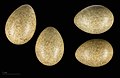 Eggs of Eremophila alpestris flava
 -
 Horned lark in Ystad 2009.


.jpg)

_-_Ystad-2009.jpg)
References
[edit]- ^ BirdLife International (2019). "Eremophila alpestris". IUCN Red List of Threatened Species. 2019 e.T22717434A137693170. doi:10.2305/IUCN.UK.2019-3.RLTS.T22717434A137693170.en. Retrieved 12 November 2021.
- ^ Linnaeus, Carl (1758). Systema Naturae per regna tria naturae, secundum classes, ordines, genera, species, cum characteribus, differentiis, synonymis, locis (in Latin). Vol. 1 (10th ed.). Holmiae (Stockholm): Laurentii Salvii. p. 166.
- ^ Catesby, Mark (1729–1732). The Natural History of Carolina, Florida and the Bahama Islands (in English and French). Vol. 1. London: W. Innys and R. Manby. p. 32.
- ^ Mayr, Ernst; Greenway, James C. Jr, eds. (1960). Check-List of Birds of the World. Vol. 9. Cambridge, Massachusetts: Museum of Comparative Zoology. p. 76.
- ^ Boie, Friedrich (1828). "Bemerkungen über mehrere neue Vogelgattungen". Isis von Oken (in German). 21. Cols 312–328 [322].
- ^ a b Gill, Frank; Donsker, David; Rasmussen, Pamela, eds. (December 2023). "Nicators, Bearded Reedling, larks". IOC World Bird List Version 14.1. International Ornithologists' Union. Retrieved 26 June 2024.
- ^ Jobling, James A (2010). The Helm Dictionary of Scientific Bird Names. London: Christopher Helm. pp. 42, 148. ISBN 978-1-4081-2501-4.
- ^ Alström, P.; Mohammadi, Z.; Enbody, E.D.; Irestedt, M.; Engelbrecht, D.; Crochet, P.-A.; Guillaumet, A.; Rancilhac, L.; Tieleman, B.I.; Olsson, U.; Donald, P.F.; Stervander, M. (2023). "Systematics of the avian family Alaudidae using multilocus and genomic data". Avian Research. 14 100095. Bibcode:2023AvRes..1400095A. doi:10.1016/j.avrs.2023.100095.
- ^ a b Drovetski, Sergei V.; Raković, Marko; Semenov, Georgy; Fadeev, Igor V.; Red'kin, Yaroslav A. (2014-01-01). "Limited phylogeographic signal in sex-linked and autosomal loci despite geographically, ecologically, and phenotypically concordant structure of mtDNA variation in the Holarctic avian genus Eremophila". PLOS ONE. 9 (1) e87570. Bibcode:2014PLoSO...987570D. doi:10.1371/journal.pone.0087570. ISSN 1932-6203. PMC 3907499. PMID 24498139.
- ^ a b Ghorbani, Fatemeh; Aliabadian, Mansour; Olsson, Urban; Donald, Paul F.; Khan, Aleem A.; Alström, Per (January 2020). "Mitochondrial phylogeography of the genus Eremophila confirms underestimated species diversity in the Palearctic". Journal of Ornithology. 161 (1): 297–312. Bibcode:2020JOrni.161..297G. doi:10.1007/s10336-019-01714-2. ISSN 2193-7192. S2CID 203439127.
- ^ CARRERA, Lisa; PAVIA, Marco; PERESANI, Marco; ROMANDINI, Matteo (2018). "Late Pleistocene fossil birds from Buso Doppio del Broion Cave (North-Eastern Italy): implications for palaeoecology, palaeoenvironment and palaeoclimate". Bollettino della Società Paleontologica Italiana (2): 145–174. doi:10.4435/BSPI.2018.10 (inactive 12 July 2025). ISSN 0375-7633.
{{cite journal}}: CS1 maint: DOI inactive as of July 2025 (link) - ^ Sánchez-Marco, Antonio (September 1999). "Implications of the avian fauna for paleoecology in the Early Pleistocene of the Iberian Peninsula". Journal of Human Evolution. 37 (3–4): 375–388. Bibcode:1999JHumE..37..375S. doi:10.1006/jhev.1999.0345. PMID 10496993.
- ^ Dussex, Nicolas; Stanton, David W. G.; Sigeman, Hanna; Ericson, Per G. P.; Gill, Jacquelyn; Fisher, Daniel C.; Protopopov, Albert V.; Herridge, Victoria L.; Plotnikov, Valery; Hansson, Bengt; Dalén, Love (2020-02-21). "Biomolecular analyses reveal the age, sex and species identity of a near-intact Pleistocene bird carcass". Communications Biology. 3 (1): 84. doi:10.1038/s42003-020-0806-7. ISSN 2399-3642. PMC 7035339. PMID 32081985. S2CID 211217336.
- ^ "Horned Lark Identification, All About Birds, Cornell Lab of Ornithology". www.allaboutbirds.org. Retrieved 2020-09-28.
- ^ "Horned Lark - Eremophila alpestris | Wildlife Journal Junior". nhpbs.org.
- ^ a b "Horned Lark Life History, All About Birds, Cornell Lab of Ornithology". www.allaboutbirds.org.
- ^ a b "Horned Lark". American Bird Conservancy.
- ^ "Horned Lark". Audubon. 13 November 2014.
- ^ de Zwaan, D.R.; Martin, K. (2018). "Substrate and structure of ground nests have fitness consequences for an alpine songbird". Ibis. 160 (4): 790–804. doi:10.1111/ibi.12582.
- ^ "Species Fact Sheet: Streaked horned lark". U.S. Fish and Wildlife Service. 2014-08-05. Retrieved 2014-08-19.
Further reading
[edit]- van den Berg, Arnoud (2005) Morphology of Atlas Horned Lark Dutch Birding 27(4):256–8
- Small, Brian (2002) The Horned Lark on the Isles of Scilly Birding World 15(3): 111–20 (discusses a possible Nearctic race bird on the Isles of Scilly in 2001)
- Dickinson, E.C.; R.W.R.J. Dekker; S. Eck & S. Somadikarta (2001). "Systematic notes on Asian birds. 12. Types of the Alaudidae". Zool. Verh. Leiden. 335: 85–126.
- Seebohm, H (1884). "On the East-Asiatic Shore-Lark (Otocorys longirostris)". Ibis. 26 (2): 184–188. doi:10.1111/j.1474-919x.1884.tb01153.x.
- Beason, Robert (1995). Horned Lark (Eremophila alpestris), version 2.0. In The Birds of North America. Ithaca, New York, USA: Cornell Lab of Ornithology.
External links
[edit]

- Picture – Cyberbirding
- Species account – Cornell Lab of Ornithology
- "Horned lark media". Internet Bird Collection.
- Horned lark – Eremophila alpestris – USGS Patuxent Bird Identification InfoCenter
- Horned lark photo gallery at VIREO (Drexel University)
- Interactive range map of Eremophila alpestris at IUCN Red List
| National | |
|---|---|
| Other | |

About
No page comments added.Synonyms
- HOLA
- Eremophila alpestris
- Eremophila alpestris [strigata Group]