From Wikipedia
Open on Wikipedia
| Matricaria discoidea | |
|---|---|

| |
| Pineappleweed | |
Scientific classification 
| |
| Kingdom: | Plantae |
| Clade: | Tracheophytes |
| Clade: | Angiosperms |
| Clade: | Eudicots |
| Clade: | Asterids |
| Order: | Asterales |
| Family: | Asteraceae |
| Genus: | Matricaria |
| Species: | M. discoidea
|
| Binomial name | |
| Matricaria discoidea | |
| Synonyms | |
|
Artemisia matricarioides auct. | |

Matricaria discoidea, commonly known as pineappleweed,[3] wild chamomile, pineapple-mayweed, disc mayweed, and rayless mayweed, is an annual plant native to North America, northern Asia, and Europe where it grows as a common herb of fields, gardens, and roadsides.[4] It is in the daisy family Asteraceae. When crushed, the flowers and foliage emit a strong pineapple-like aroma, giving the plant its common name. [5][6]
Description
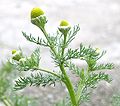
[edit]The flowers of M. discoidea, are small, dome-shaped capitula that resemble single flower heads but are composed of densely packed yellowish green corollas[7][8][9]. Each plant typically carries at least five capitula, and each capitulum measures 5–15 mm across.[8] The capitula lacks ray florets, giving the flowers their distinctive button-like appearance.[7] The capitula are typically solitary or arranged in loose clusters, and they are supported by short peduncles about 5–10 mm in length.[7] Papery bracts (small, leaf-like structures) surround the capitulum in three rows, with membranous margins and rounded tips.[7][8][10][9]
Like other members of the Asteraceae family, it produces florets with an inferior ovary.[11] The hollow, conical receptacle contains numerous tubular, bisexual disc florets, each with five stamens and a pistil formed from two fused carpels.[7][10] Matricaria species have flattened and penicillate style branches, aiding in pollen transfer.[10] Flowerheads are commonly produced from March to September.
The leaves are pinnately divided one to three times, with blades measuring approximately 10–65 mm long and 2–20 mm wide.[12][13] As an annual species, the leaves senesce along with the rest of the plant at the end of each growing season.[8]


Although the foliage appears glabrous, under high magnification it has many microscopic trichomes made of short basal cells and a long, pointed terminal cell.[5][6]
Microscopically, the leaves are amphistomatic, with stomata present on both the adaxial and abaxial surfaces, positioned close to the epidermis and flanked by oval-shaped guard cells [6]. The cuticle is thin (~2.6 μm), and the leaf surfaces show little difference between top and bottom.[6] Each square millimeter of the upper leaf surface contains 205 stomata on average, while the lower surface contains an estimated 142 stomata per mm².[6]
Internally, leaves have one large and two medium vascular bundles, along with accessory bundles and secretory canals (resin ducts) distributed throughout the mesophyll.[6] Consistent with most Asteraceae, M. discoidea uses the C₃ photosynthetic pathway.[14]
M. discoidea has a shallow root system defined by a short, thick taproot with many fine secondary fibrous roots.[5][8] The taproot descends directly from the seed’s embryo and grows vertically downward.
Distribution and habitat
[edit]The plant thrives in disturbed areas, especially those with poor, compacted soil. It often blooms along footpaths and roadsides in spring and early summer. It occurs across Canada and the United States, especially as a common weed in Alaska, the Yukon, and the Northwest Territories.[15] However, there is disagreement over whether it originated in North America or in Siberia.[16][17] This species has been introduced to Europe, Asia, Iceland, South America, and New Zealand[18] and is now widespread and naturalized in Britain, where it has become one of the fastest-spreading plants of the 20th century.[19][20]
Reproduction
[edit].jpg)
M. discoidea reproduces solely through seed formation.[21] The flower heads produce small, light brown, ribbed seeds measuring 1.3–1.6 mm in length by <0.7 mm in width and weighing 0.14 mg on average.[7][22][23] Each seed is enveloped in a 19.6-22.8 μm-thick seed coat and packaged in a small, dry, indehiscent fruit achene.[24][22]
Flowering occurs rapidly under favorable conditions. In temperate environments such as England, M. discoidea may flower only 37–50 days after seedling emergence, depending on temperature and day length.[25] Shorter photoperiods and later-season germination extend the time to flowering, often causing overwintering as a rosette before blooming the following spring.[25]
Individual flower heads produce 50-400 seeds.[21][26] The main plant has been observed to produce up to six thousand seeds in the United Kingdom, while in Alaska the main plant usually contains 11-1000 seeds.[26][21] Pineapple weed readily fertilizes itself,[27][28] and the species typically produces seeds one or more times per year.[21]
Buried M. discoidea seeds have been found to quickly lose viability at an estimated rate of 15% per year over their first ten years, although they generally remain viable for a minimum of three years.[29][21] Similarly, seeds experience a steep decline in dormancy in the initial years after burial.[29] Successful germination requires light and open, disturbed soil, as seeds buried too deeply will not sprout.[21]
Ecology
[edit]Seeds are very easily dispersed by water, adhesion to animals, human activity, and motor vehicles.[21] A study by Dunmail J. Hodkinson and Ken Thompson found that M. discoidea is one of the most common plants to be transported in this way.[30]
The roots of pineapple weed are colonized by arbuscular mycorrhizal fungi.[31][32] These mycorrhizae give the plant greater access to water as well as nutrients like phosphorus, nitrogen, sulfur, and trace elements.[32]
Despite M. discoidea’s ability to self-pollinate, insect pollination also occurs. [33][34] Its pollen has been identified in brood cells of Megachile versicolor (leafcutter bee).[34] Butterflies have also been known to drink nectar from the flowers of Matricaria species.[35]
Uses
[edit]The greens can be washed and eaten, and both the flowers and the whole plant can be steeped to make tea,[36] described as "excellent" by one field guide.[37] They have also been used in salads (although they may become bitter by the time the plant blooms). Extracts from the flowers and other aerial parts of the plant have been shown to possess non-toxic, pain-relieving, and mildly sedative effects, reflecting the biological activity concentrated in the floral tissues. [38]
Gallery
[edit]-
 The pinnately dissected leaves are sweet-scented when crushed
 -
-

-

-


_-_geograph.org.uk_-_497544.jpg)

References
[edit]- ^ NRCS. "Matricaria discoidea". PLANTS Database. United States Department of Agriculture (USDA). Retrieved 2008-06-14.
- ^ Germplasm Resources Information Network (GRIN) (2005-09-07). "Taxon: Matricaria discoidea DC". Taxonomy for Plants. USDA, ARS, National Genetic Resources Program, National Germplasm Resources Laboratory, Beltsville, Maryland. Archived from the original on 2008-04-22. Retrieved 2008-06-14.
- ^ BSBI List 2007 (xls). Botanical Society of Britain and Ireland. Archived from the original (xls) on 2015-06-26. Retrieved 2014-10-17.
- ^ "Pineapple Mayweed". NatureGate.
- ^ a b c Patton, Aaron; Beck, Leslie; Daniel, Kyle. "Spotlight on Weeds: Pineapple weed". Purdue Landscape Report. Retrieved 2025-12-06.
- ^ a b c d e f Inceer, Huseyin; Ozcan, Melahat (2011-10-01). "Leaf anatomy as an additional taxonomy tool for 18 taxa of Matricaria L. and Tripleurospermum Sch. Bip. (Anthemideae-Asteraceae) in Turkey". Plant Systematics and Evolution. 296 (3): 205–215. Bibcode:2011PSyEv.296..205I. doi:10.1007/s00606-011-0487-2. ISSN 1615-6110.
- ^ a b c d e f Zargar, Shabir A.; Khuroo, Anzar Ahmad; Reshi, Zafar A.; Ganie, Aijaz Hassan (2024-05-22), Naturalization of Pineapple-weed (Matricaria discoidea DC.) in the Indian Trans-Himalayan region of Ladakh, doi:10.21203/rs.3.rs-4306097/v1, retrieved 2025-12-06
- ^ a b c d e Inceer, Huseyin; Bal, Murat (2019). "Morphoanatomical study of Matricaria L. (Asteraceae) in Turkey". Botanica Serbica. 43 (2): 151–159. Bibcode:2019BoSer..43..151I. doi:10.2298/BOTSERB1902151I. ISSN 1821-2158.
- ^ a b Claßen-Bockhoff, Regine; Baczyński, Jakub; Hanke, Veronika; Henkes, Svenja Sibylla; Ferdinand, Nadine (2025-07-09). "Are capitula inflorescences? A reassessment based on flower-like meristem identity and ray flower development". Annals of Botany mcaf144. doi:10.1093/aob/mcaf144. ISSN 0305-7364.
- ^ a b c Arriagada, Jorge E.; Miller, Norton G. (1997). "The Genera of Anthemideae (compositae; Asteraceae) in the Southeastern United States". Harvard Papers in Botany. 2 (1): 1–46. ISSN 1043-4534. JSTOR 41761535.
- ^ Munro, Marian C.; Newell, Ruth E.; Hill, Nicholas M. (2014). "3-9 Asteraceae, aster family". Nova Scotia Museum.
- ^ Huette, T (September 29, 2025). "Invasive Plants and Exotic Weeds of Southeast Alaska" (PDF). invasive.org. Retrieved September 29, 2025.
- ^ "Matricaria discoidea - FNA". floranorthamerica.org. Retrieved 2025-12-06.
- ^ Yang, Hong; Liu, Weiguo; Leng, Qin; Hren, Michael T.; Pagani, Mark (2011-03-01). "Variation in n-alkane δD values from terrestrial plants at high latitude: Implications for paleoclimate reconstruction". Organic Geochemistry. 42 (3): 283–288. Bibcode:2011OrGeo..42..283Y. doi:10.1016/j.orggeochem.2011.01.006. ISSN 0146-6380.
- ^ Walsh, Stanley L. (1974). Anderson's flora of Alaska and adjacent parts of Canada. Provo: Brigham Young University Press. ISBN 0-8425-0705-1.
- ^ "Matricaria discoidea DC". Plants of the World Online. Royal Botanic Gardens, Kew. Retrieved 21 February 2024.
- ^ Brouillet, Luc (5 November 2020). "Matricaria discoidea - FNA". Flora of North America. Retrieved 21 February 2024.
- ^ Hultén, Eric (June 1968). Flora of Alaska and Neighboring Territories. Stanford, CA: Stanford University Press. ISBN 9780804706438.
- ^ P.A. Stroh; T. A. Humphrey; R.J. Burkmar; O.L. Pescott; D.B. Roy; K.J. Walker (eds.). "Matricaria discoidea DC". BSBI Online Plant Atlas 2020. Botanical Society of Britain and Ireland. Retrieved 21 February 2024.
- ^ The Wildlife Trusts, "Pineappleweed" http://www.wildlifetrusts.org/species/pineappleweed
- ^ a b c d e f g Densmore R., McKee P.C., and Roland C. 2001. “Exotic Plants in Alaskan National Park Units.” https://accs.uaa.alaska.edu/wp-content/uploads/Exotic_Plants_in_Alaskan_National_Park_Units.pdf
- ^ a b Royer F. and Dickinson R. 1999. Weeds of the Northern U.S. and Canada: A Guide for Identification. University of Alberta. ISBN 978-1-55105-221-2. Google-Books-ID: ebFUcfN2enIC. Accessed September 20, 2025.
- ^ Dostál, Petr (2010-12-01). "Post-dispersal seed mortality of exotic and native species: Effects of fungal pathogens and seed predators". Basic and Applied Ecology. 11 (8): 676–684. Bibcode:2010BApEc..11..676D. doi:10.1016/j.baae.2010.10.001. ISSN 1439-1791.
- ^ Shil A. and Mukherjee S. K. 2016. “Diversity of cypselar anatomy in nine species of the tribe Anthemideae (Asteraceae).” Indian Journal of Plant Sciences, 5(3), 95-105. ISSN: 2319–3824. DOI:10.13140/RG.2.2.16660.50561
- ^ a b Roberts, H. A.; Feast, Patricia M. (1974). "Observations on the Time of Flowering in Mayweeds". Journal of Applied Ecology. 11 (1): 223–229. Bibcode:1974JApEc..11..223R. doi:10.2307/2402017. ISSN 0021-8901. JSTOR 2402017.
- ^ a b ADHB. 2008. “Distribution and biology of pineappleweed in the UK.” Agriculture and Horticulture Development Board. https://ahdb.org.uk/knowledge-library/distribution-and-biology-of-pineappleweed-in-the-uk
- ^ Mitsuoka, Sachihiko; Ehrendorier, Friedrich (1972-02-01). "Cytogenetics and evolution of Matricaria and related genera (Asteraceae-Anthemideae)". Österreichische botanische Zeitschrift. 120 (1): 155–200. Bibcode:1972PSyEv.120..155M. doi:10.1007/BF01373265. ISSN 1615-6110.
- ^ Ehrendorfer, Friedrich (1970). "Evolutionary Patterns and Strategies in Seed Plants". Taxon. 19 (2): 185–195. Bibcode:1970Taxon..19..185E. doi:10.2307/1217953. ISSN 1996-8175. JSTOR 1217953.
- ^ a b Conn J. S., Beattie K. L., and Blanchard A. 2006. "Seed Viability and Dormancy of 17 Weed Species after 19.7 Years of Burial in Alaska." Weed Science, 54(3), 464-470. https://doi.org/10.1614/WS-05-161R.1
- ^ Hodkinson, Dunmail J.; Thompson, Ken (1997). "Plant Dispersal: The Role of Man". Journal of Applied Ecology. 34 (6): 1484–1496. Bibcode:1997JApEc..34.1484H. doi:10.2307/2405264. ISSN 0021-8901. JSTOR 2405264.
- ^ Štajerová, Marie Šmilauerová, Šmilauer, K., M., P. (2009). Arbuscular mycorrhizal symbiosis of herbaceous invasive neophytes in the Czech Republic. pp. Preslia 81, 341–355.
{{cite book}}: CS1 maint: multiple names: authors list (link) - ^ a b Sokornova, Sonya; Malygin, Daniil; Terentev, Anton; Dolzhenko, Viktor (2022-12-18). "Arbuscular Mycorrhiza Symbiosis as a Factor of Asteraceae Species Invasion". Agronomy. 12 (12): 3214. Bibcode:2022Agron..12.3214S. doi:10.3390/agronomy12123214. ISSN 2073-4395.
- ^ Géron, Charly; Lembrechts, Jonas J.; Hamdi, Rafiq; Berckmans, Julie; Nijs, Ivan; Monty, Arnaud (2022-12-01). "Phenotypic variation along urban-to-rural gradients: an attempt to disentangle the mechanisms at play using the alien species Matricaria discoidea (Asteraceae)". Plant Ecology. 223 (10): 1219–1231. Bibcode:2022PlEco.223.1219G. doi:10.1007/s11258-022-01269-y. ISSN 1573-5052.
- ^ a b Gresty, Catherine E. A.; Clare, Elizabeth; Devey, Dion S.; Cowan, Robyn S.; Csiba, Laszlo; Malakasi, Panagiota; Lewis, Owen T.; Willis, Katherine J. (2018). "Flower preferences and pollen transport networks for cavity-nesting solitary bees: Implications for the design of agri-environment schemes". Ecology and Evolution. 8 (15): 7574–7587. Bibcode:2018EcoEv...8.7574G. doi:10.1002/ece3.4234. ISSN 2045-7758. PMC 6106195. PMID 30151172.
- ^ Dover, John W. (1996). "Factors Affecting the Distribution of Satyrid Butterflies on Arable Farmland". Journal of Applied Ecology. 33 (4): 723–734. Bibcode:1996JApEc..33..723D. doi:10.2307/2404943. ISSN 0021-8901. JSTOR 2404943.
- ^ Nyerges, Christopher (2017). Foraging Washington: Finding, Identifying, and Preparing Edible Wild Foods. Guilford, CT: Falcon Guides. ISBN 978-1-4930-2534-3. OCLC 965922681.
- ^ Benoliel, Doug (2011). Northwest Foraging: The Classic Guide to Edible Plants of the Pacific Northwest (Rev. and updated ed.). Seattle, WA: Skipstone. p. 123. ISBN 978-1-59485-366-1. OCLC 668195076.
- ^ Sepp, Janne; Koshovyi, Oleh; Jakštas, Valdas; Žvikas, Vaidotas; Botsula, Iryna; Kireyev, Igor; Severina, Hanna; Kukhtenko, Oleksandr; Põhako-Palu, Kaisa; Kogermann, Karin; Heinämäki, Jyrki; Raal, Ain (2024-03-18). "Phytochemical, Pharmacological, and Molecular Docking Study of Dry Extracts of Matricaria discoidea DC. with Analgesic and Soporific Activities". Biomolecules. 14 (3): 361. doi:10.3390/biom14030361. ISSN 2218-273X. PMC 10968509. PMID 38540779.
External links
[edit]
- USDA Plants Profile for Matricaria discoidea (Disc mayweed, Pineapple weed)
- Jepson Manual treatment: for Chamomilla suaveolens —Matricaria discoidea
- University of Michigan Native American Ethnobotany — Matricaria discoidea
- Pineapple weed - Matricaria discoidea
- Robbins, W. W., Margaret K. Bellue, and Walter S. Ball. 1970. Weeds of California. Documents and Publications, Sacramento. 547 p.
- Gregory L. Tilford. 1997. Edible and Medicinal Plants of the West. Mountain Press Publishing Company, Missoula. 110 p.
- University of California-Davis, Statewide Integrated Pest Management Program — 'Pineapple weed'
- "Matricaria matricarioides". Plants for a Future.
- Matricaria discoidea in the CalPhotos photo database, University of California, Berkeley
About
No page comments added.Synonyms
- Disc Mayweed