From Wikipedia
Open on Wikipedia
| Neottia bifolia | |
|---|---|

| |
Scientific classification 
| |
| Kingdom: | Plantae |
| Clade: | Tracheophytes |
| Clade: | Angiosperms |
| Clade: | Monocots |
| Order: | Asparagales |
| Family: | Orchidaceae |
| Subfamily: | Epidendroideae |
| Genus: | Neottia |
| Species: | N. bifolia
|
| Binomial name | |
| Neottia bifolia (Raf.) Baumbach[1]
| |
| Synonyms[1] | |
| |

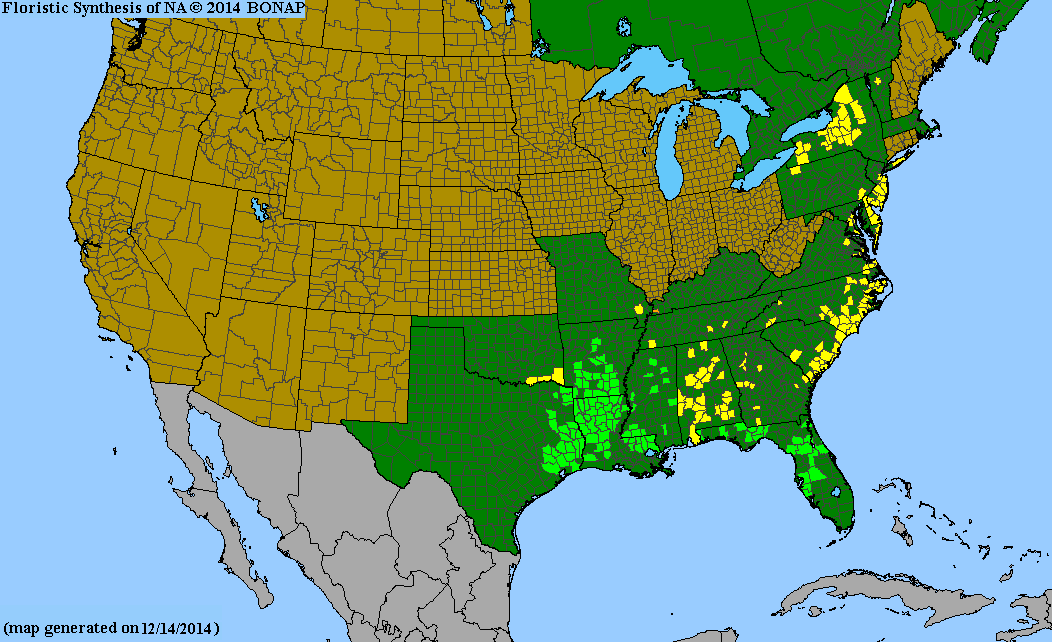
Neottia bifolia (syn. Listera australis), commonly known as the southern twayblade, is a species of terrestrial orchid native to eastern Canada (from Nova Scotia to Ontario) and the eastern United States (from Florida west to eastern Texas and north to Vermont).[1][2][3][4]
Description
[edit]Neottia bifolia is a small terrestrial orchid typically bearing two opposite, ovate leaves.[5] The inflorescence is a raceme producing about 25 red-purple to slightly green flowers, and the labellum is bilobed and tapered into fine points.[5]
Habitat and ecology
[edit]Neottia bifolia occurs in wet forested habitats, including sphagnous swamps and peatland forests.[6] In Nova Scotia, it has been documented in black spruce–tamarack swamps.[6] A long-term monitoring study found declines associated with wetland-edge disturbance, altered runoff, and loss of Sphagnum, and suggested that the species may serve as an indicator of ecosystem integrity in such wetlands.[6]
Conservation status
[edit]Neottia bifolia is ranked G5 (Secure) globally by NatureServe, indicating that the species is widespread and not considered at risk of extinction across its range.[7]
The species has not been evaluated by the International Union for Conservation of Nature (IUCN) and does not have an official IUCN Red List status.
Despite its global security, the species is considered rare or imperiled in parts of its range, particularly toward the northern limits of its distribution.[8] NatureServe lists state and provincial conservation ranks ranging from S1 (critically imperiled) to S4 (apparently secure) depending on region.[8]
The species occurs in more than 900 documented occurrences across eastern North America.[8] Potential threats include forest management activities, land development, hydrological alteration, invasive species, deer browse, and recreational disturbance.[8] However, because of its broad geographic range, relatively large number of populations, and availability of suitable wetland habitat, the species is not currently considered globally threatened.[8]
Genetics
[edit]In 2020, the complete plastid genome of Neottia bifolia was reported as 156,533 base pairs in length.[5] Comparative analysis with other members of Neottia supported the placement of N. bifolia among the chlorophyllous species of the genus, most often in a clade with N. cordata, N. japonica, and N. suzuki.[5]
References
[edit]- ^ a b c "Neottia bifolia". World Checklist of Selected Plant Families. Royal Botanic Gardens, Kew. Retrieved 2012-04-05.
- ^ "Plants Profile for Listera australis (southern twayblade)". USDA Plants. USDA Natural Resources Conservation Service. Retrieved 2012-04-05.
- ^ "Southern twayblade, Listera australis Lindley". Flora of North America. p. 587.
- ^ "Biota of North America Program, 2013 county distribution map, Neottia bifolia".
- ^ a b c d Rentsch, Jeremy D.; Hardee, Landon J.; Shelley, Caroline E.; Williams, Morghan T. (2020). "The complete plastid genome of Neottia bifolia (Raf.) Baumbach (Orchidaceae): Insights into chlorophyllous and achlorophyllous plastid genomes". Castanea. 85 (2): 285–295.
- ^ a b c Hill, Nicholas M.; Crowell, Michael; Lapaix, Rich; Hicks, Shawn (2018). "The rare southern twayblade (Neottia bifolia): sentinel of ecosystem integrity for sphagnous swamps". Rhodora. 120 (982): 117–142. doi:10.3119/17-11.
- ^ "Listera australis". NatureServe Explorer. Retrieved 2026-03-16.
- ^ a b c d e "Listera australis". NatureServe Explorer. Retrieved 2026-03-16.